Wool & Cottage

The Kind of Yarn That Changes the Entire Feel of a Project - and Supports Artisans Around the World

Molly Grimm

Darn Good Yarn Makers Stash - Use code MOLLYMS15 for 15% off your order!

Every once in a while, a yarn shows up that immediately makes you want to cast something on.

It’s not always that we need another project (most of us probably don’t), but because the texture, color, and feel of it sparks ideas the second you touch it!

That was my first reaction to the Darn Good Yarn Makers Stash.

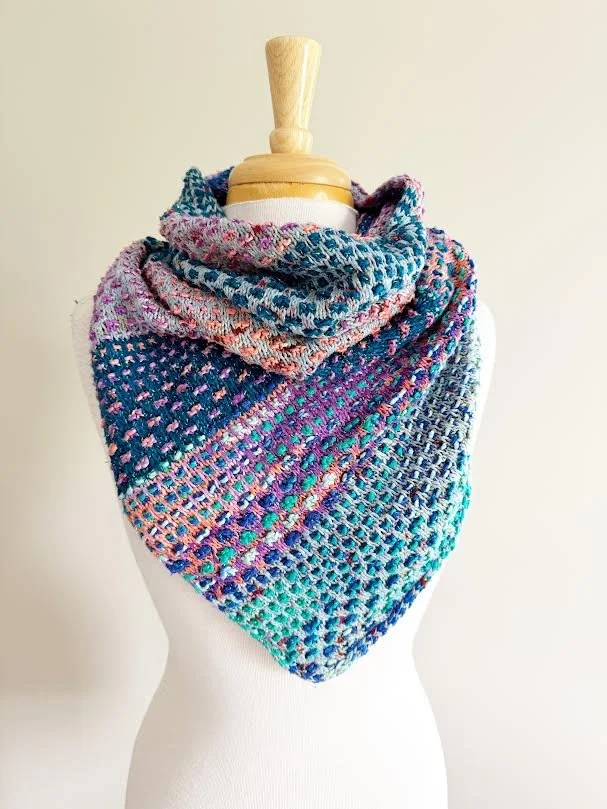
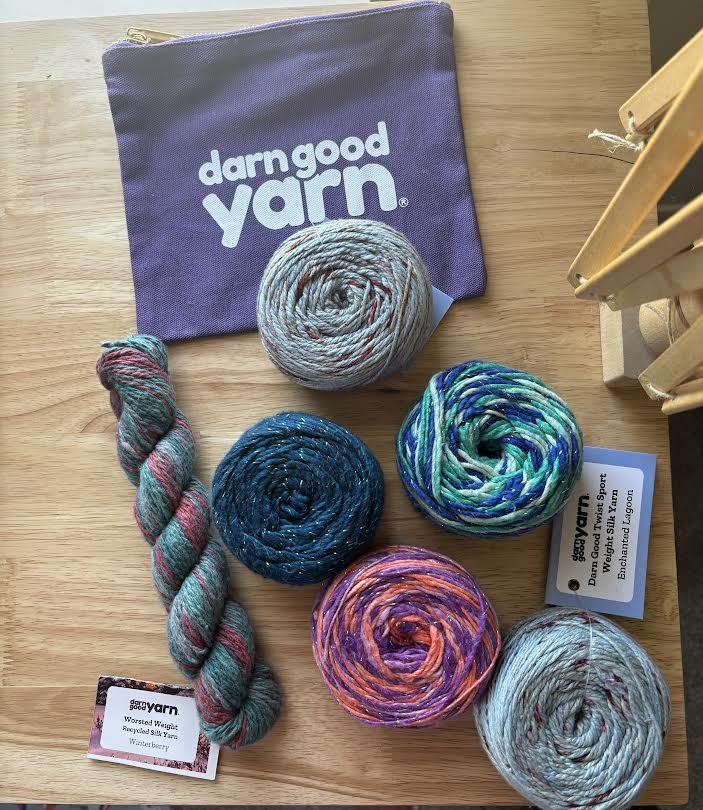
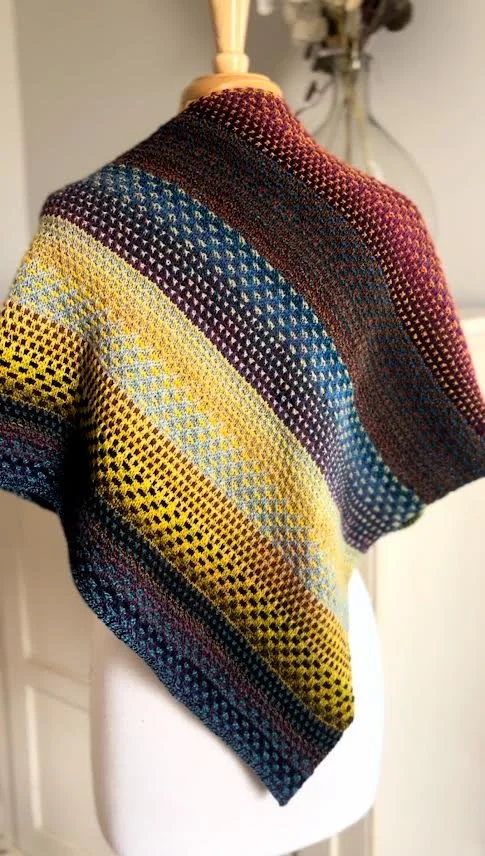
I received five skeins recently, and the color I keep coming back to is Enchanted Lagoon - which is still available on the website right now if you’ve been curious about trying it. The colors have so much depth in person, and because every skein is hand dyed, they all vary slightly from one another.

It doesn’t feel flat or overly uniform - It really feels artistic - Like yarn with actual personality!

This makers stash yarn comes in various weights.

And because it’s made from reclaimed sari silk materials, the texture has this really unique feel to it that’s different from a lot of traditional yarns. It already has me thinking about shawls, lightweight garments, and fun textured accessories.

I also received one of their recycled silk worsted weight yarns in the color Winterberry, which is equally as unique in person.

I have a few project ideas in mind already, but I want to spend a little time swatching and checking gauge before I start officially recommending patterns. Some yarns need a little experimenting before you know exactly what they want to become!

But what really made me want to share this company was not just the yarn itself.

The more I learned about Darn Good Yarn, the more I realized this is one of those rare companies where the mission actually feels connected to the product in a meaningful way.

Their yarns are handmade by artisans in India and Nepal using reclaimed materials, and the company works with over 600 artisans to help provide safe working conditions and livable wages - opportunities that unfortunately aren’t always accessible in many textile industries.

A lot of us spend hours knitting with these materials. It’s nice when the yarn itself carries a story beyond just the finished object.

They also partner with Trees for the Future and plant trees through their subscription program - one tree planted for every subscriber every month.

So if you’ve been wanting to try:

- recycled silk yarn

- hand dyed yarn with texture and variation

- more sustainable fiber options

- or simply something that feels a little different from the usual…

this might be worth exploring.

There are so many beautiful color options available, but Enchanted Lagoon immediately became my favorite!

You can browse the yarns here:

Darn Good Yarn

And if you decide to try something, you can use my affiliate code:

MOLLYMS15 for 15% off.

This post contains affiliate links and/or affiliate codes. If you purchase through them, I may earn a small commission at no extra cost to you. Thank you for supporting Knitting Wellness and the content I share here.

The Dragonfly Sweater, and the Rip-Back I Needed

Molly Grimm
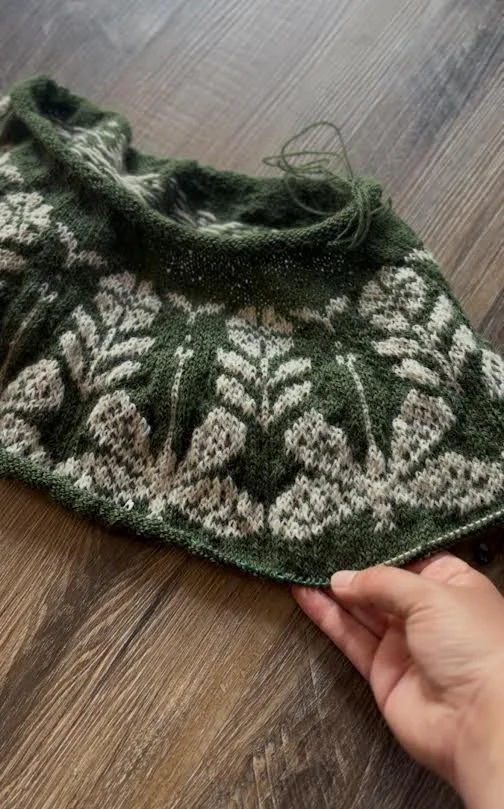
Hand knit sweater yoke with dragonfly and floral motif

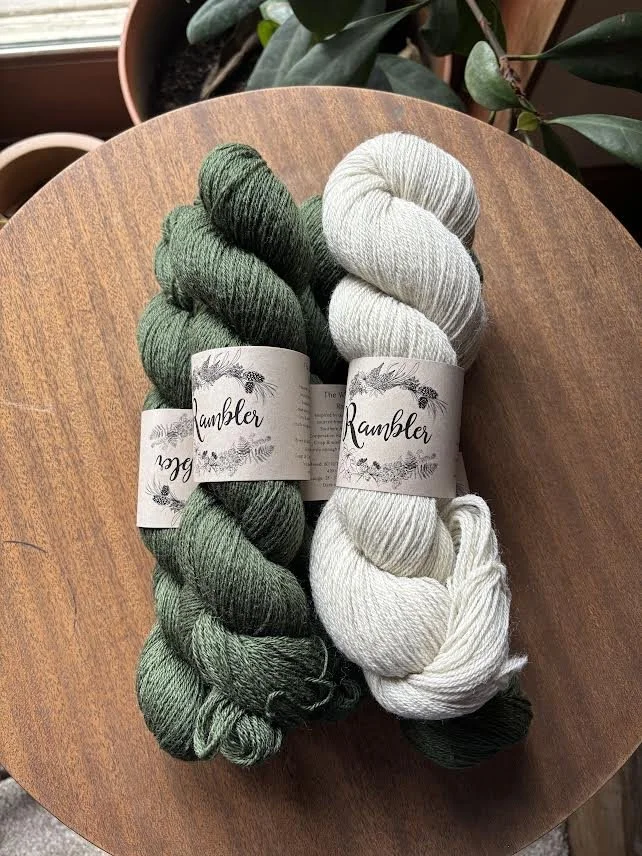
The Rambler Yarn by Woolly Thistle

Dragonfly Sweater by Elenor Mortenson

This post contains affiliate links. If you purchase through my links, I may earn a small commission at no extra cost to you. I only share products I genuinely love and would recommend regardless.

Yarn: The Rambler by Woolly Thistle

Pattern: Dragonfly Sweater by Elenor Mortenson


There’s a particular kind of humility that knitting can teach you - the kind that arrives usually somewhere around row 40, when you hold your work up to the light and realize something has gone wrong in a way you can’t quite name yet.

That was me, a week or so into my new project: the Dragonfly Sweater by Elenor Mortensen. A colorwork sweater, top-down, knit in the round in one piece. Raglan increases from a provisional cast on, stranded technique throughout, short rows for shaping. It is, on paper, a project that asks a lot of you.

And somewhere in my yoke, I had twisted my stitches without noticing!

So I ripped it back to the beginning, made myself a cup of tea, and started again.

Why This Pattern

I’m drawn to patterns that feel like they hold something - a mood, a world, a little mystery. The Dragonfly Sweater does that. There are options for floral or beetle motifs worked into the colorwork, and you can customize the design in ways that make the finished sweater genuinely yours. That kind of built-in flexibility is rare, and it makes the knitting feel more like a collaboration than a set of instructions to follow.

The pattern itself has been wonderfully clear. Even working through the provisional cast on and into the raglan shaping - techniques that can sometimes feel like reading a map in a foreign language - I’ve found Mortensen’s directions easy to trust. The rip-back wasn’t the pattern’s fault. It was mine, and the pattern made it easy to find my way back.

The Yarn: The Rambler for The Woolly Thistle

Now. Can we talk about this yarn for a moment?

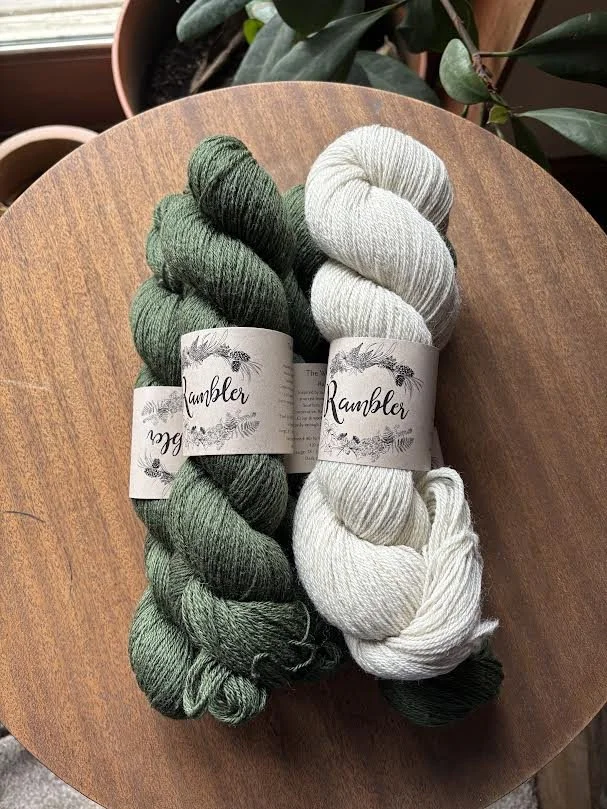
Green and white skeins of yarn

The original pattern calls for a fingering weight superwash sock yarn, which would be beautiful. But I chose something different: The Rambler, a woolly sock yarn made exclusively for The Woolly Thistle - and only available there.

And you can feel it!

The Rambler has that quality that superwash yarns, for all their practicality, can never quite replicate: it has memory. It breathes. It grips itself in the way that makes stranded colorwork a genuine pleasure rather than a wrestling match — the floats lie flat, the tension stays even, and the fabric you’re creating has a warmth and loft to it that you can sense even before you’ve finished the yoke.

I’m working in a deep, mossy dark green and a soft stone neutral for the contrast, and even in these early rows, the combination is exactly what I hoped it would be.

If you’re considering a colorwork project and you haven’t worked with a woolly (non-superwash) sock yarn before, The Rambler is a beautiful place to start.

Where I Am Now

I’m only to the yoke. There’s a whole sweater still ahead of me: the body, the sleeves, the moment when it starts to look like a *thing* and not just a growing tube of color. I’m in no rush.

That’s what I love most about a project like this one. It asks you to stay present, to count carefully, to notice when something has gone subtly wrong — and to begin again without catastrophizing about it.

The rip-back taught me something. It always does!

I’ll be sharing more updates as this sweater grows. If you’re also casting on for the Dragonfly Sweater, I’d love to know — especially which motif you chose!

Knitting Another Colorwork Cuff Club Sock (Floral Motif Edition!)

Molly Grimm
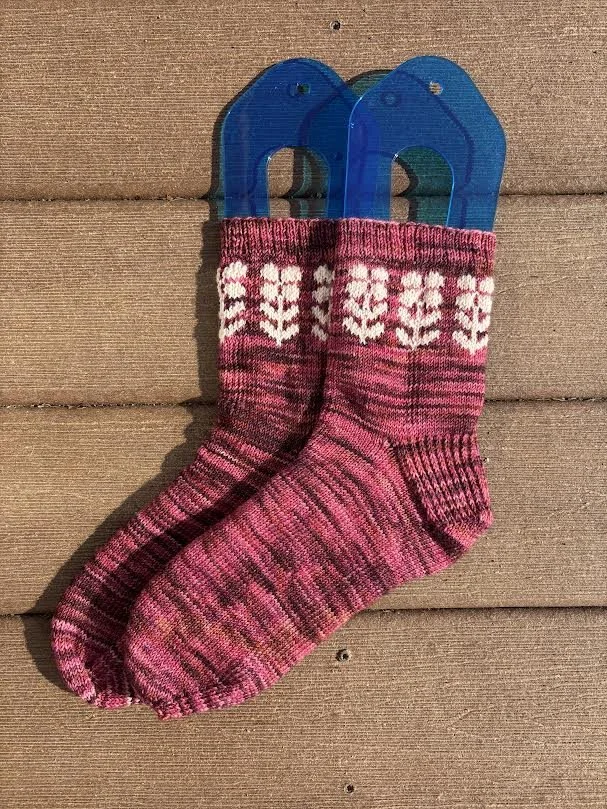
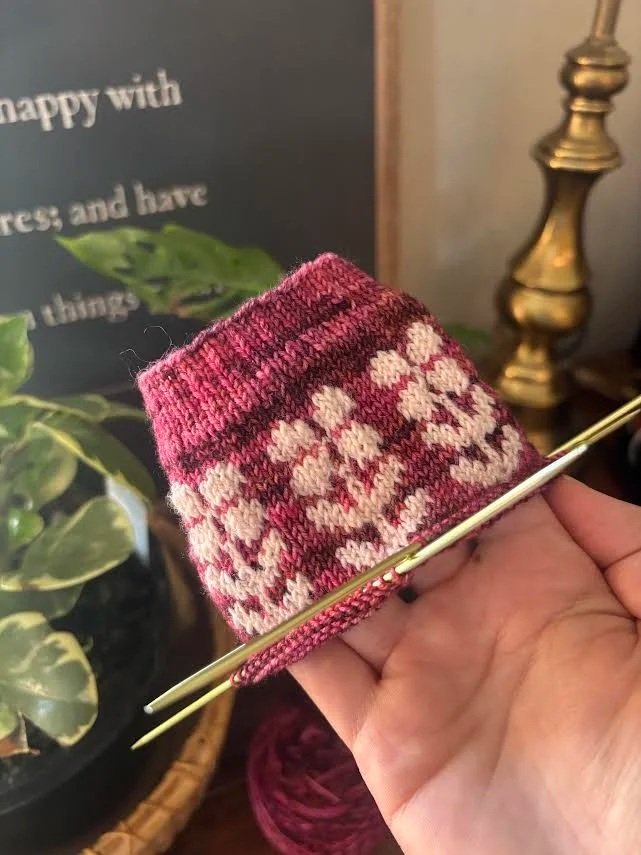
Pink knit socks with floral cuff for the motif

Gazzal Happy Feet Sock Yarn in colorway 3263

Pattern: Color Cuff Club Volume 1 by Summer Lee Knits (August 2024)

If you’ve been following along here for a while, you know I have a soft spot for a well-written sock pattern — and Summer Lee of Summer Lee Knits consistently delivers. This post is all about my experience knitting the first installment of her Colorwork Cuff Club from the August 2024 release that kicked off a 12-month series of colorwork sock charts.

The Colorwork Cuff Club is a year-long colorwork adventure built around a base sock pattern. Each month, a new colorwork chart is released that plugs right into that base, with the rest of the sock worked in relaxing stockinette.

This was my third Summer Lee sock, and I have to say, her patterns genuinely get easier to follow each time. The instructions are clear, the construction is intuitive, and the result is a great-fitting sock. If you’ve ever been intimidated by colorwork, this is a wonderful place to start.

The Yarn

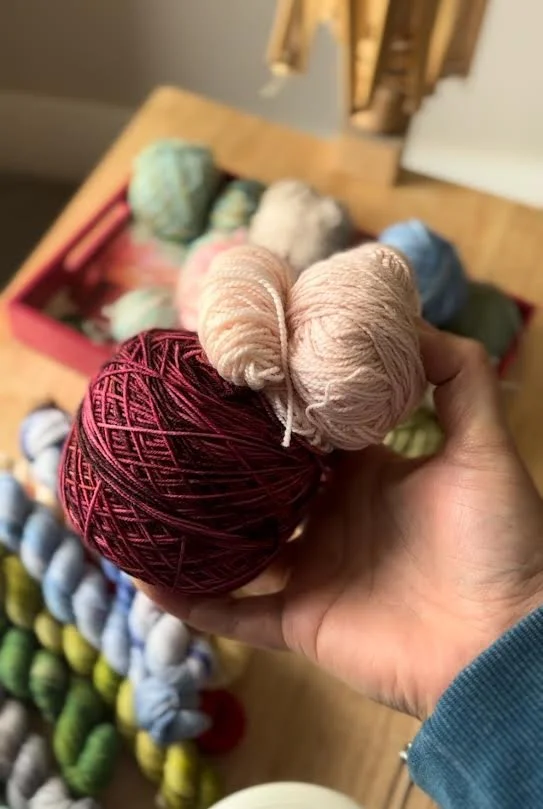
two balls of yarn one light pink and one dark pink

For the main sock, I used Gazzal Happy Feet Sock Yarn in colorway 3263, gifted to me by Candy Yarn Shop. Candy Yarn Shop is a small business based out of Ukraine with a wonderful selection of affordable yarns — they carry a variety of colors and restock frequently, so it’s always worth checking back. (This particular colorway isn’t available right now, but I’ll link the shop below so you can browse what they currently have!)

For the floral motif on the colorwork cuff, I pulled from a mini skein from one of Emma’s Yarns mini sets — a light pink sock yarn that was absolutely perfect for the job. If you have any light pink sock yarn mini hanging around, that’s genuinely all you need for this element. It’s a small amount but makes such a sweet impact.

Both yarns were a dream to work with — smooth, consistent, and easy on the hands for a project that kept me happily knitting from start to finish.

Final Thoughts

floral hand knit sock cuff pink

This is one of those projects that reminds me why I love knitting. The pattern is well-written, the colorwork chart is approachable, and the finished sock fits beautifully. If you’re a sock knitter and haven’t explored Summer Lee’s patterns yet, I really can’t recommend them enough. And if you’re already a fan, the Colorwork Cuff Club is such a fun way to build your skills (and your sock collection!) month by month.

W&C’s website contains affiliate links, meaning I may earn a small commission if you purchase through any links at no extra cost to you.

Thank you for supporting this blog!

Knitting + Tea: A Simple Way to Slow Down

Molly Grimm

If slowing down has ever felt harder than it should, you’re not the only one.

Most of us are used to constant stimulation.
Phones, noise, notifications, something always pulling our attention.

So when things get quiet, it doesn’t always feel calming right away.

Sometimes it just feels… unfamiliar.

Something Simple to Come Back To

That’s why I keep coming back to something really simple:

knitting + a cup of tea

Nothing complicated.
No pressure to do it “right.”
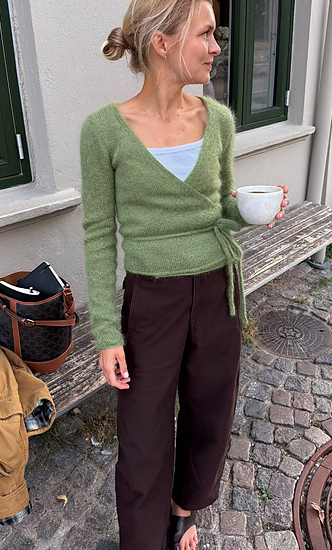
Just something steady to return to.

Knitting gives your hands something to do.
Tea gives you a reason to pause.

And together, it creates a rhythm that feels a little easier to settle into.

Why This Works (In Real Life)

This isn’t about creating the perfect routine.

It’s about having something consistent.

  • a few rows of knitting

  • a warm cup nearby

  • a quiet moment (even if it’s short)

That’s it.

You don’t need a full hour.
You don’t need a perfectly calm house.

Even a few minutes can shift how you feel.

The Tea I Keep Reaching For

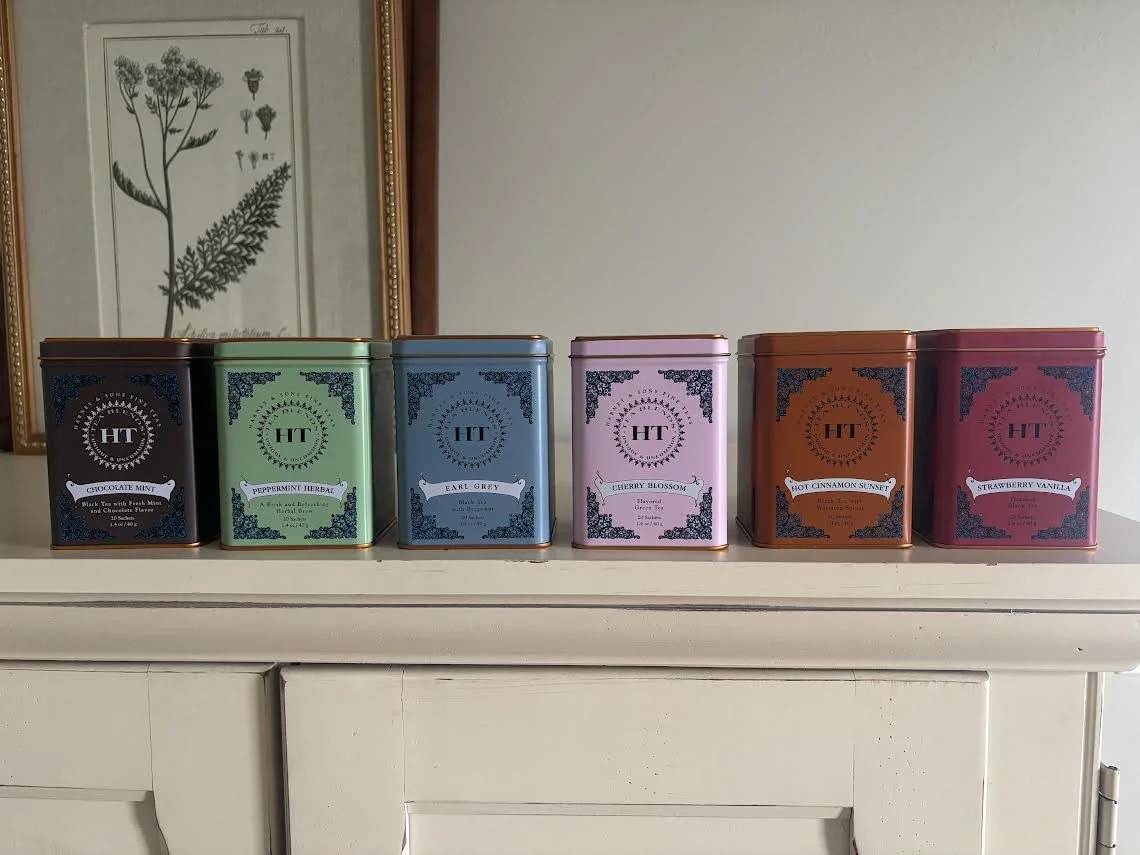
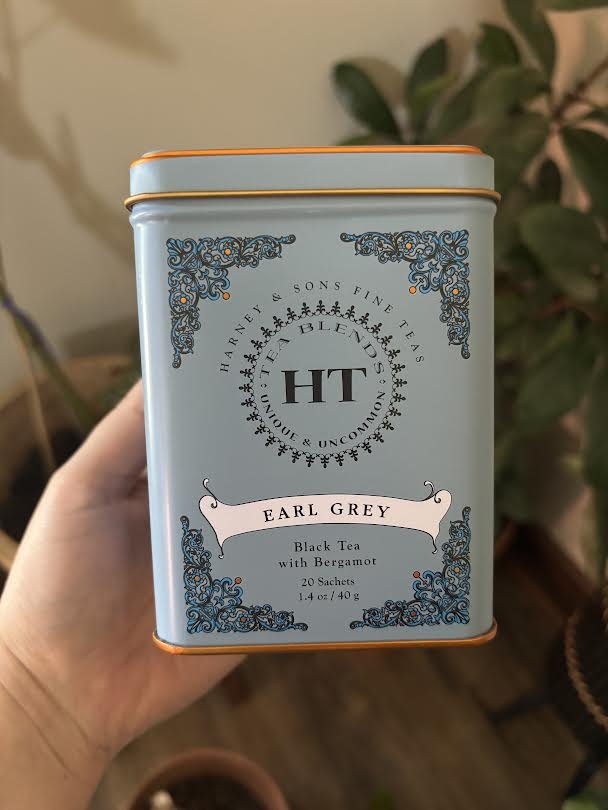
I’ve had Harney & Sons next to my projects for years.

One I come back to often is Earl Grey — it’s simple, familiar, and easy to reach for without thinking too much about it.

It’s become part of the routine more than anything else.

What I’m Knitting

I always keep a project nearby — something I can pick up without needing to overthink it.

You can find all of my current projects, patterns, and notes here

A Small Place to Start

If you’ve been trying to slow down and it hasn’t felt easy, start here.

Not with a big routine.
Not with something perfect.

Just something simple you can come back to.

Knitting.
Tea.
A few quiet minutes.

That’s enough.

Affiliate Note

Some of the links on this page are affiliate links, which means I may earn a small commission at no extra cost to you. I only share what I genuinely use and enjoy.

What You Need to Start

Color Cuff Club Socks (WIP) – From Stash to Stitch

Molly Grimm
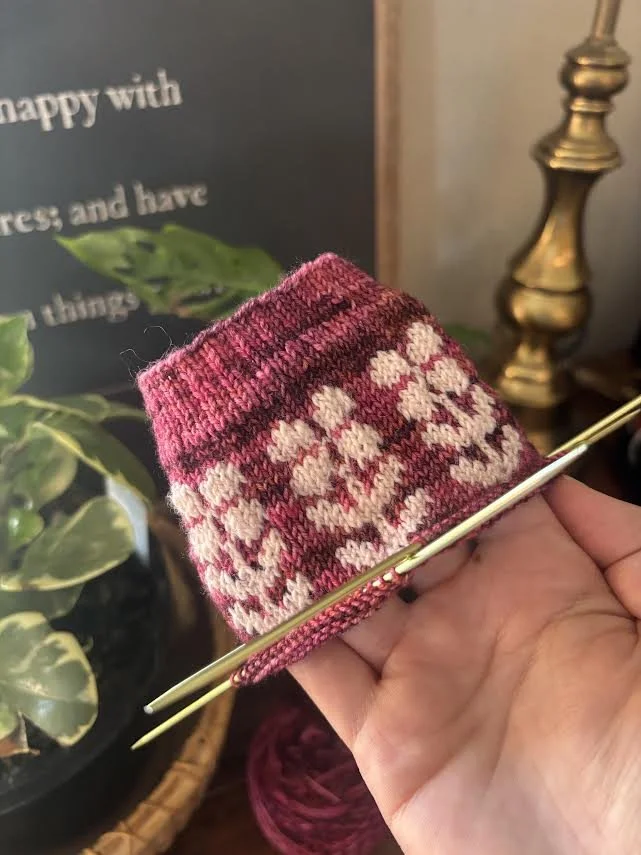
Holding unfinished sock project with floral colorwork detail

There’s something really satisfying about finally reaching for yarn that’s been sitting in your stash for a while.

This project is part of my From Stash to Stitch series this year - working through what I already have, using what I’ve loved enough to hold onto, and giving those yarns a purpose!

Right now, I’m working on a pair of socks from Color Cuff Club Volume 1 by Summer Lee, and they’ve been such a fun project to have on my needles.

The Yarn (A Stash Story)

This yarn has been waiting for the right project.

The main yarn is from Candy Yarn Shop, which was gifted to me, and I originally had a completely different shawl in mind for it. But no matter what I tried, I just couldn’t get gauge to work the way I wanted.

So it sat in my stash for a while.

Then I came across this pattern from Summer Lee, and it made more sense with the gauge I was getting.

For the floral cuff, I added a fingering weight mini from Emma’s Yarn, which I picked up from Simply Socks Yarn Company. It ended up being the perfect contrast for the colorwork.

There’s something really satisfying about pairing yarns from different moments and seeing them come together like this.

The Pattern

The Color Cuff Club Volume 1 socks feature a floral colorwork cuff that adds just enough detail without overwhelming the rest of the sock.

It’s a really approachable way to add colorwork into a project - especially if you don’t want to commit to it for the entire sock.

The cuff feels like the highlight, while the rest of the sock stays simple and relaxing.

What It’s Like So Far

Even though this project isn’t finished yet, it’s already one I look forward to picking up.

The colorwork at the cuff keeps things interesting, and once that section is done, it transitions into a more rhythmic knit.

It’s been a really nice balance - a little bit of focus, followed by something more familiar and calming.

From Stash to Stitch

This project is exactly why I started this series on Instagram.

There’s so much yarn we hold onto because we loved it at one point - even if the original plan doesn’t work out. Sometimes it just takes time (and the right pattern) for it to come together.

I’m really glad I didn’t force the first project. This feels like a much better fit.

Final Thoughts (For Now)

This one isn’t finished yet, but it already feels like a project I’m going to love wearing.

It’s simple, but with just enough detail to make it feel special - and it’s always nice when a stash yarn finally finds its place.

I’ll share more once they’re finished, but for now, this is one I’m really enjoying.

Links & Resources

Candy Yarn Shop Yarn: https://tidd.ly/4dmSATX

Affiliate Disclaimer

This post may contain affiliate links. I may earn a small commission at no additional cost to you. I only share products and resources I personally use and enjoy.

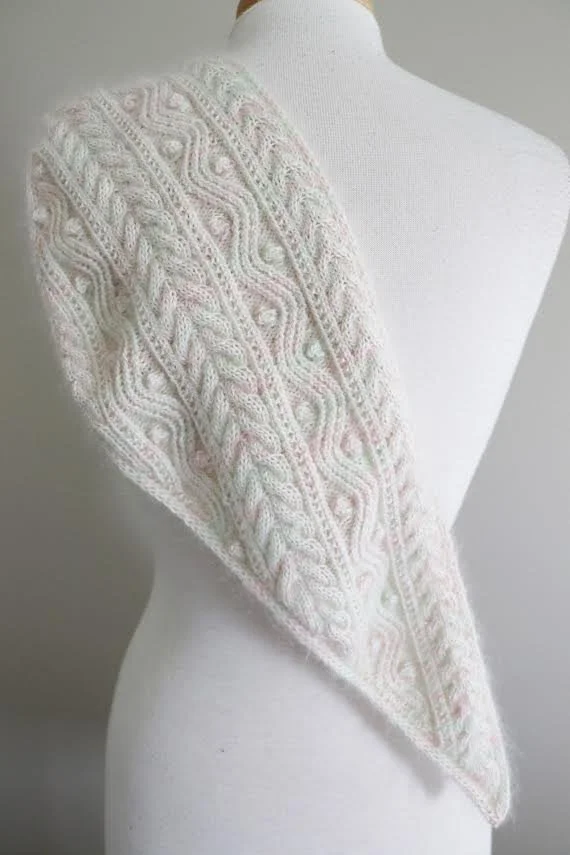
Turtle Dove Shawl by Sari Nordlund (Finished Project)

Molly Grimm
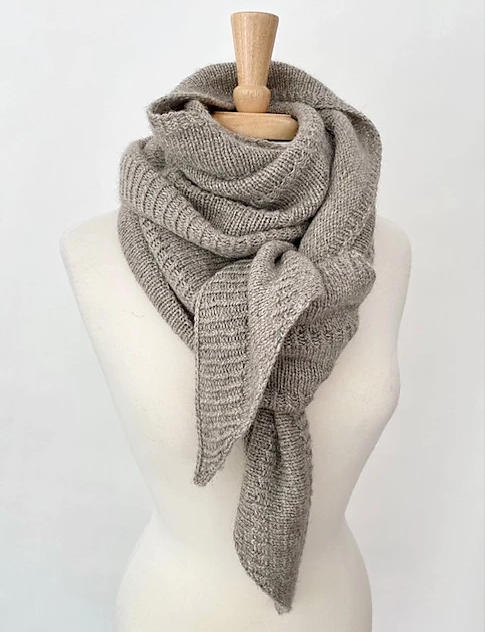
Cabled hand knit scarf draped over mannequin

There’s something really satisfying about finishing a project that slowly becomes part of your routine.

I recently finished the Turtle Dove Shawl by Sari Nordlund, and it ended up being one of those knits that I kept coming back to - not because I had to, but because I wanted to!

This is a project I shared a bit of while it was still in progress, and now that it’s finished, it feels like one worth documenting fully.

The Yarn Combination

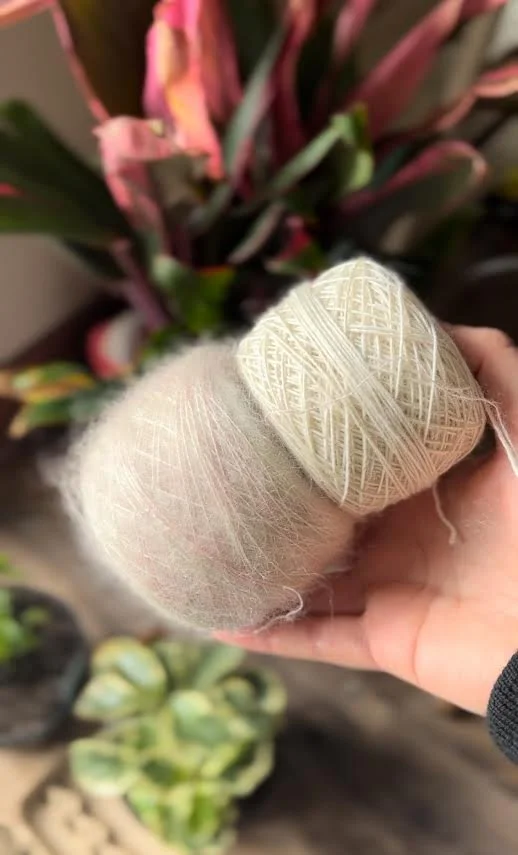
2 Balls of yarn - mohair and light fingering weight

One of the reasons this project feels so special is the yarn combination.

I’m holding together two yarns that really complement each other in a way that feels effortless.

The first is Island Dyeworks Mohair from The Stitchery of Saint Simons, hand-dyed by Ms. Bo. This mohair is incredibly soft and creates that light, delicate halo that gives the fabric an airy, almost dreamy feel.

It’s also a bit of a hidden gem. It’s not something you’ll easily find online - most of the time you have to call the shop or visit in person to see what she has dyed, which makes it feel even more special to work with.

To pair with the mohair, I used Araucania Yarns Nuble, a wool and silk blend that adds just enough structure and drape to balance everything out. This yarn has since been discontinued, but any light fingering weight yarn would work beautifully held together with this mohair.

Together, they create a fabric that feels really beautiful without trying too hard. The silk adds a subtle sheen and strength, while the mohair softens everything and gives it that gentle glow.

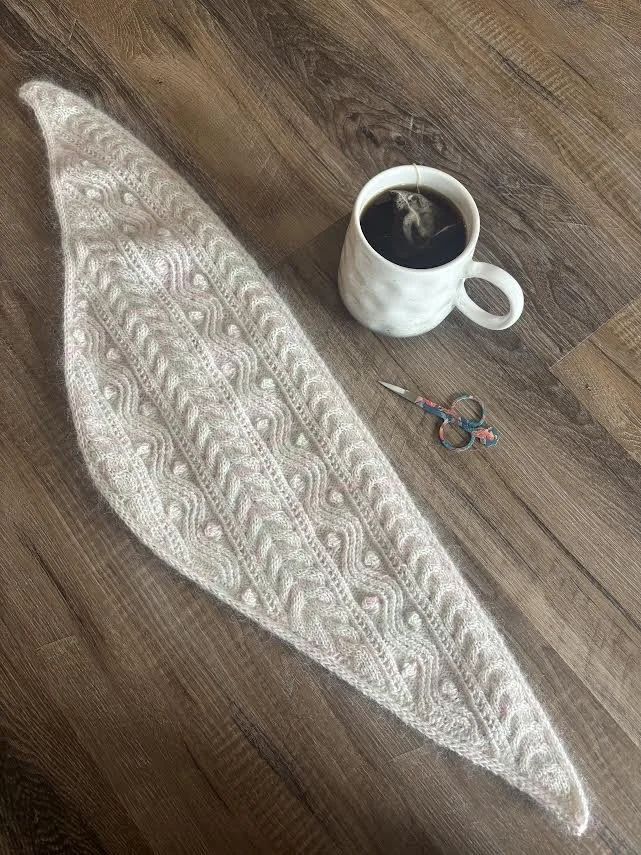
The end result is light, airy, and elegant - exactly what I was hoping for in this shawl!

What It Was Like to Knit

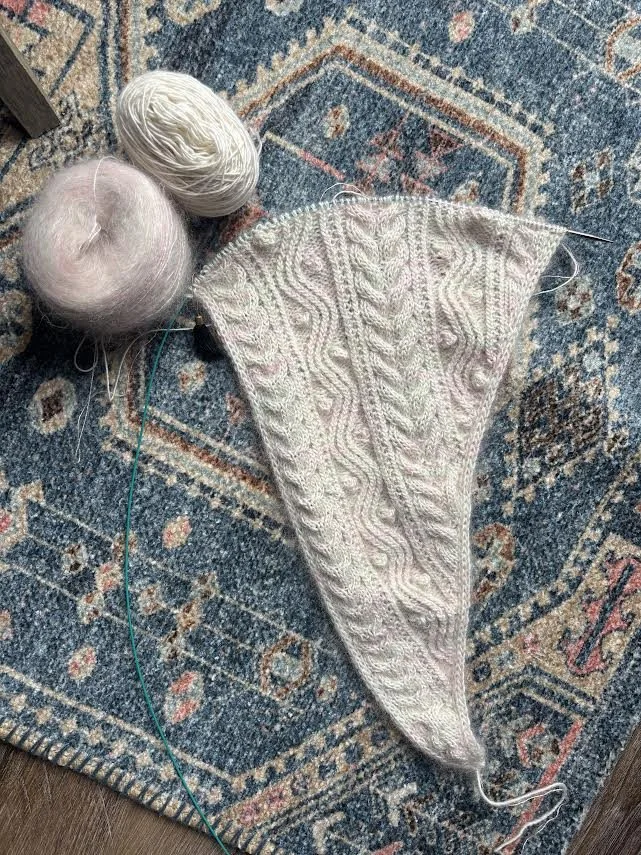
Half of completed shawl project with cables on a colorful rug

This is one of those patterns that sits right in the middle - it does require your attention, especially at the beginning, but once the stitch sequence is memorized, it becomes very rhythmic.

It’s not something I could fully “zone out” on right away, but it never felt stressful either. Once I found the rhythm, it became a really steady, enjoyable knit.
Those are usually my favorite kinds of projects - the ones that keep your hands and mind engaged, but still feel calming over time.

A Project That Slows You Down

There’s something about this pattern that naturally encourages you to slow down a bit.

You’re paying attention, but not in a pressured way. Just enough to stay present with what you’re doing.

And as the shawl grows, you start to see that progress build - which always feels grounding in its own way.

Final Thoughts

This ended up being one of those projects I’m really glad I took the time to make.

It’s thoughtful without being overwhelming, structured but still relaxing once you settle into it.

If you’re looking for a shawl that:

keeps your attention

becomes rhythmic over time

and pairs beautifully with mohair

this is definitely one to consider.

Photo of completed cabled shawl on wooden background with tea and scissors
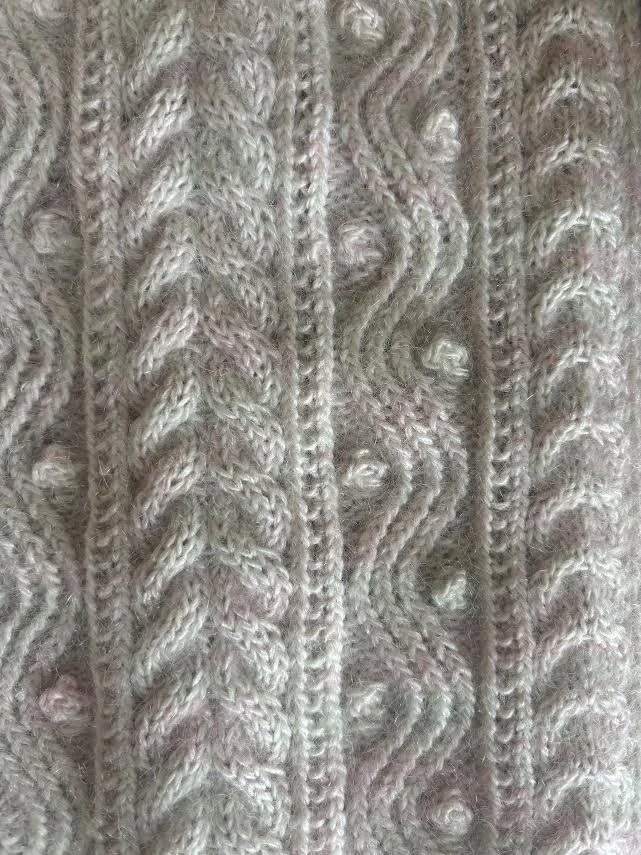
Close up of cables, bobbles, and details of shawl

A Small Knitting Reset: Tea & a Few Quiet Rows

Molly Grimm

This post may contain affiliate links. I may earn a small commission at no additional cost to you.

Teas I’m Enjoying While Knitting

Shop the Teas Featured

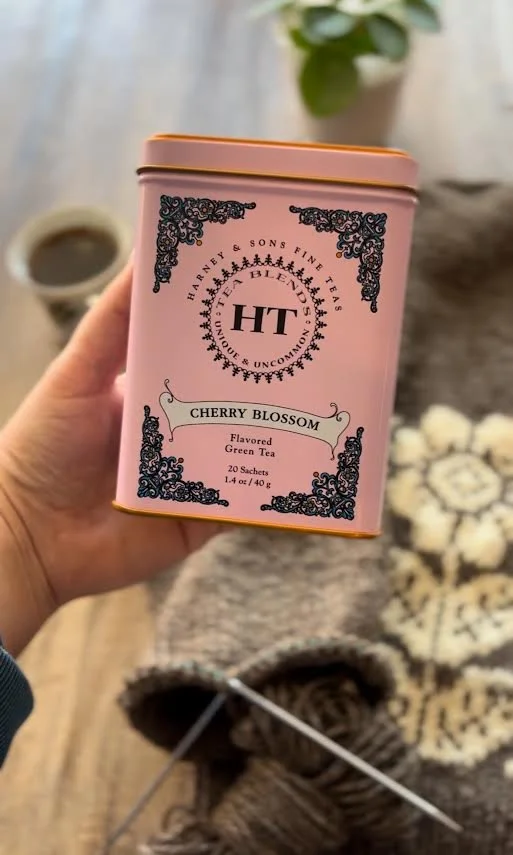
🍵 Cherry Blossom Tea

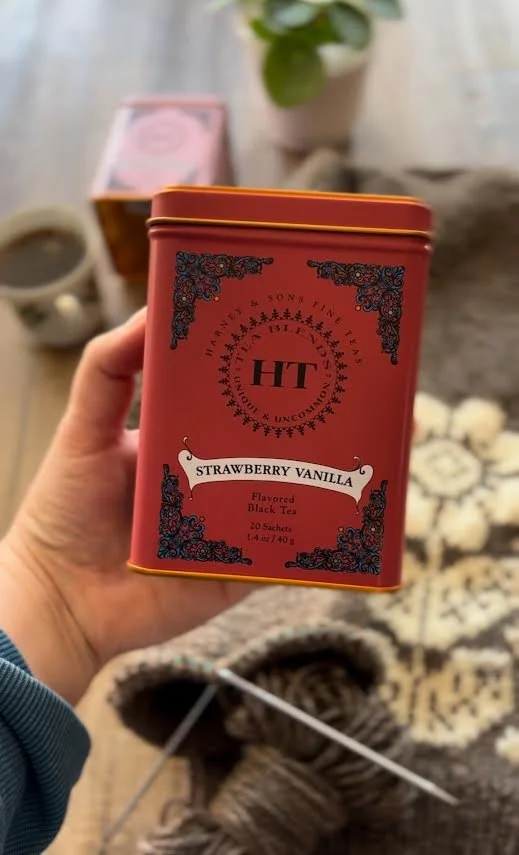
🍓 Strawberry Vanilla Black Tea

Harney & Sons has been part of my knitting routine for years. In the quiet, everyday rhythm that happens when you sit down with a project and take a breath before the next row.

There’s a moment in the day when everything starts to feel rushed. Messages, errands, decisions, work. It’s easy to move from one thing to the next without ever really pausing.

For me, that pause usually looks like this:

A cup of tea.

A few rows of knitting.

& Nothing complicated.

Just something warm in my hands while the needles move.

Why Tea and Knitting Work So Well Together

Knitting is built on repetition — the same small movement again and again. That repetition has a way of slowing the mind down and helping your attention settle.

Tea does something similar in its own quiet way. The act of steeping, waiting, and taking that first sip creates a small moment of transition.

When the two come together, it becomes a simple ritual:

steep the tea

pick up the project

knit a few rows

let the day soften a little

It doesn’t have to take an hour. Even ten or fifteen minutes can change the tone of an afternoon.

The Teas I’m Currently Enjoying

For this little knitting reset lately, I’ve been reaching for two teas from Harney & Sons that feel especially nice for spring.

Harney & Sons Fine Teas Cherry Blossom Flavor

🌸 Cherry Blossom Tea

Light and floral with a gentle sweetness, this one feels like the kind of tea you’d want during a quiet afternoon knit. It’s delicate without being overly perfumed.

👉 Shop Cherry Blossom Tea here

Harney & Sons Fine Teas Strawberry Vanilla Flavor

🍓 Strawberry Vanilla Black Tea

This one is a little warmer and richer. The strawberry brings a soft brightness while the vanilla rounds everything out. It’s been especially nice while working on longer knitting sessions.

👉 Shop Strawberry Vanilla Tea here

My Current Knitting Project

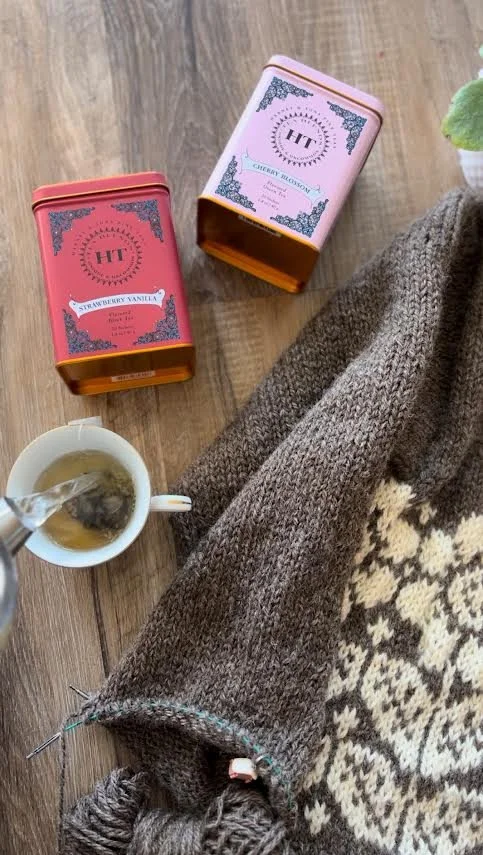
Tea being poured next to a knitting project
Tea and knitting project

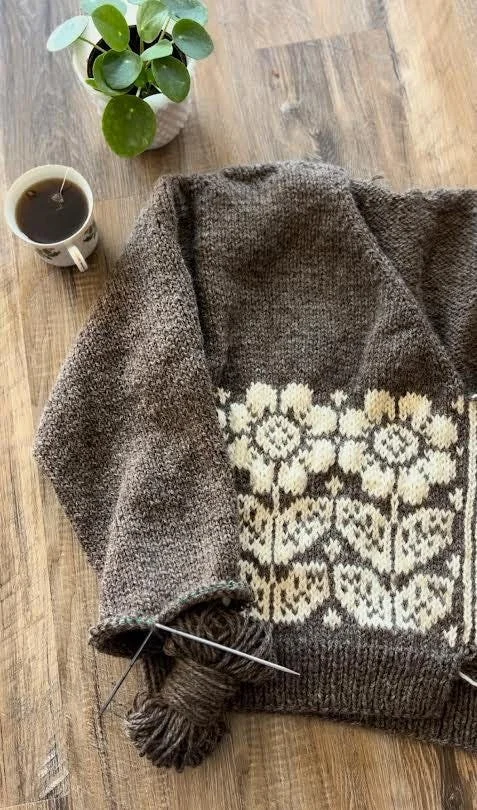
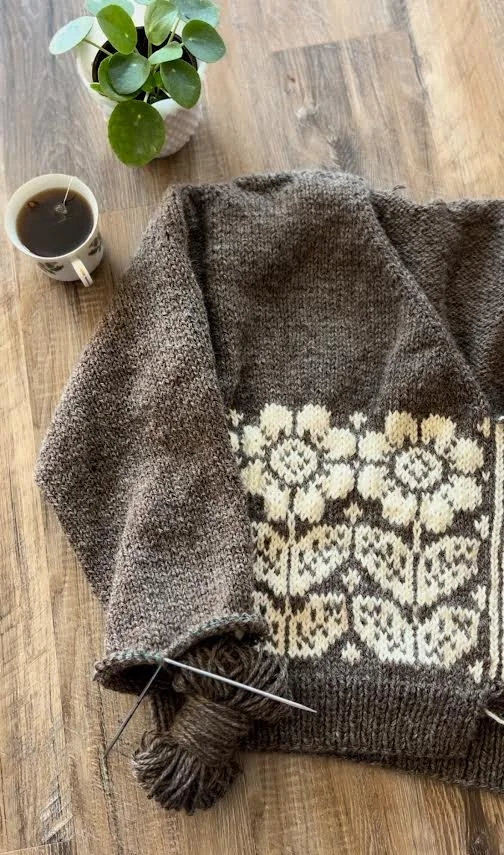
While enjoying these teas, I’ve been working on the Nordic Bloom Cardigan by Caitlyn Hunter, which has been a really enjoyable knit so far. I’m using Beatrice Bayliss Chunky Wool. Projects like this are perfect for pairing with a good cup of tea — something engaging but relaxing enough to settle into.

That combination of warm tea and steady stitches is one of the reasons I love knitting so much. It turns ordinary moments into something slower and more intentional.

Creating Your Own Knitting Ritual

If you knit — or even if you’re just starting — I highly recommend creating a small ritual around it.

It doesn’t need to be complicated.

Just something simple like:

making a cup of tea

sitting down with your yarn

knitting a few rows without rushing

Those small pauses add up.

And sometimes the best part of the day is simply a warm drink and a quiet row of stitches.

Shop the Teas Featured

🍵 Cherry Blossom Tea

🍓 Strawberry Vanilla Black Tea

Disclosure: This post contains affiliate links. If you purchase through these links, I may earn a small commission at no additional cost to you. I only share products I genuinely enjoy using in my knitting routine.

A Soft, Airy Knit: My Turtle Dove Shawl in Progress

Molly Grimm
Unfinished cable knitting project on a rug

Turtle Dove Shawl by Sari Nordlund

Every now and then a project comes along that feels a little extra special right from the start. The Turtle Dove Shawl by Sari Nordlund has been one of those projects for me.

This is a pattern I’ve had on my list for a while, and once I finally cast it on, I was pleasantly surprised by how approachable it feels to knit.

The pattern is charted, which might look a little intimidating at first glance, but once you settle into the rhythm of the charts, it’s actually very manageable. After a few repeats, the stitches begin to make sense and the pattern starts to flow naturally.

A Truly Luxurious Yarn Pairing

One of the reasons this project feels so special is the yarn combination.

I’m holding together two yarns that complement each other beautifully.

First is Island Dyeworks Mohair from the Stitchery of Saint Simons, hand dyed by Ms. Bo herself. This mohair is incredibly soft and creates a delicate halo that gives the fabric that dreamy, airy quality many knitters love in shawls.

This yarn is a bit of a hidden gem. It’s not something you can easily find online — you typically have to call the shop or visit in person to see what Ms. Bo has dyed.

To pair with the mohair, I’m using Araucania Yarns Nuble, a beautiful wool and silk blend that adds structure and drape to the fabric.

Together, the two yarns create something that feels genuinely luxurious. The silk blend provides strength and sheen, while the mohair adds softness and that gentle halo effect.

The fabric feels light, airy, and elegant — exactly what I hoped for in this shawl.

Picture of yarn

Getting Comfortable with the Charts

Like many shawls, the Turtle Dove Shawl relies on charts for the stitch pattern.

At first, the chart requires a little attention, but it’s not overly complicated. Once I worked through the first few repeats and understood how the stitches interacted with each other, it became much easier to follow.

In fact, I’d describe it as one of those patterns that becomes surprisingly relaxing once it clicks.

It keeps you engaged without feeling stressful, which makes it a great project for evenings when you want to focus on something creative but still unwind.

A Project I’m Enjoying Slowing Down With

So far, this shawl has been a joy to knit. The combination of the soft halo from the mohair, the subtle sheen of the silk blend, and the elegant lace pattern makes each section feel rewarding as it grows.

It’s one of those projects where you pause every now and then just to look at the fabric and appreciate how the stitches are coming together.

If you enjoy textured shawls and beautiful yarn pairings, the Turtle Dove Shawl by Sari Nordlund is definitely worth exploring. The pattern is available on Ravelry, and once you get comfortable with the charts, it’s a surprisingly approachable knit.

I’m looking forward to seeing how this one continues to grow!

A Colorful Sock Knit: My Project from the Color Cuff Club Vol. 2

Molly Grimm
Picture of knit socks on the ground

Color Cuff Club Volume 2 by Summer Lee

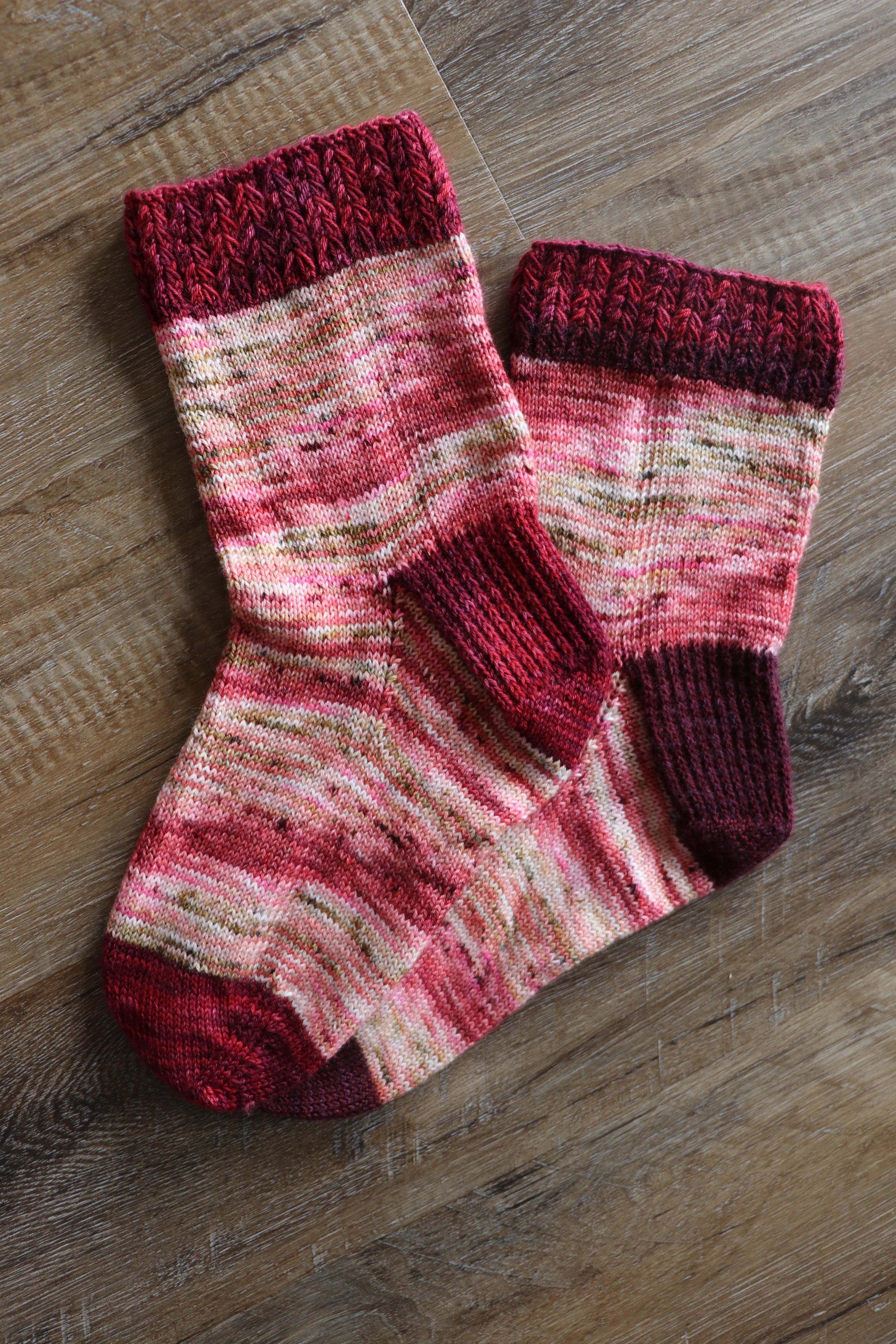
One of the projects I finished recently was a pair of socks from Color Cuff Club Volume 2, the monthly sock pattern series by Summer Lee. The club includes 12 patterns released throughout the year, each one featuring a different decorative cuff while keeping the base sock construction the same.

I knit the November 2025 release, and it ended up being one of those projects that’s both visually interesting and surprisingly relaxing once you settle into the rhythm.

The Design: Dip Stitch Cluster Cuff

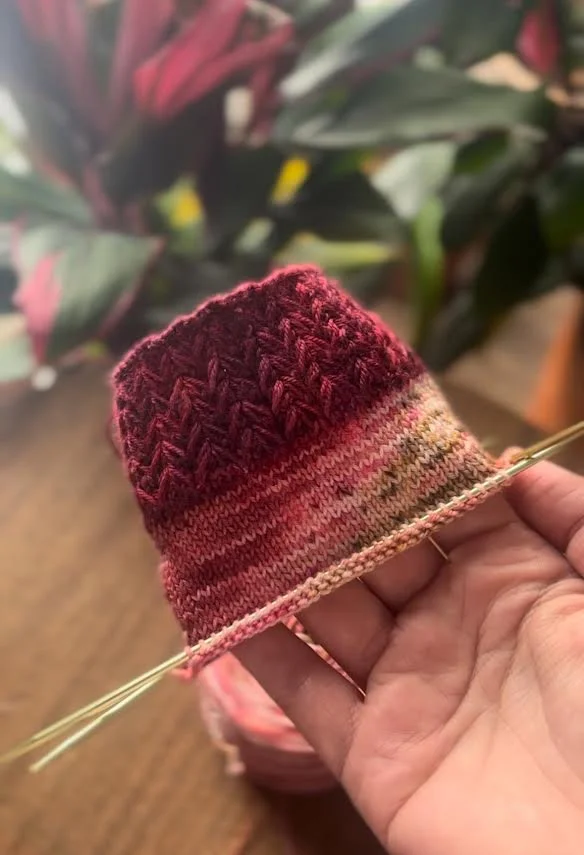
Picture of unfinished sock, cuff only

What makes this particular sock stand out is the dip stitch cluster pattern on the cuff. It creates a really pretty texture and adds visual interest right at the top of the sock.

It’s one of those stitch patterns that might take a moment to understand when you first start — especially on smaller needles — but once it clicks, it’s very satisfying to knit.

The dip stitches create a subtle layered effect that makes the cuff feel a little more special than a typical ribbed sock cuff.

Getting Used to the Needles

For this project I used double-pointed needles (DPNs), and like many sock knitters know, it can take a minute to settle into the rhythm when working with such small needles.

At first I had to slow down and pay attention to the stitch pattern and needle management. But once I got comfortable with the flow of the cuff and the needle setup, the project moved along quickly.

One of the nice features of this series is that the base sock construction stays the same across the patterns, which means after the cuff section you can settle into a familiar rhythm.

That makes it a great balance between:

learning something new at the cuff

and knitting something comfortably familiar for the rest of the sock.

Yarn Details

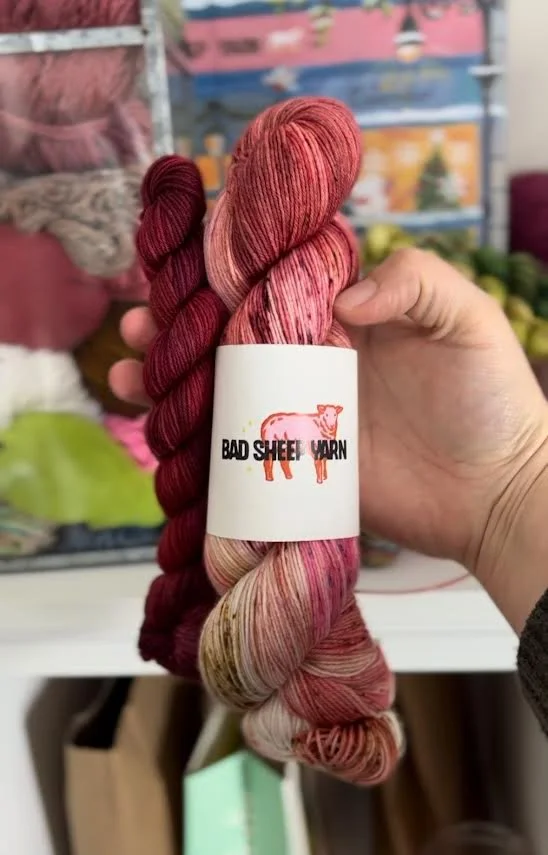
Picture of red yarns used in project

For this pair I used:

Bad Sheep Yarn Fingering Weight

Colorway: Lotus

I paired the main yarn with a couple of minis from the Bad Sheep Yarn 2024 Advent Calendar that had been sitting in my stash waiting for the right project. Unfortunately, the minis I used are discontinued and I don’t remember the exact color names, but they worked decently with the main color.

Using stash minis for cuffs, heels, or toes is one of my favorite ways to add interest to socks while also using up small amounts of yarn.

A Great Sock Pattern to Try

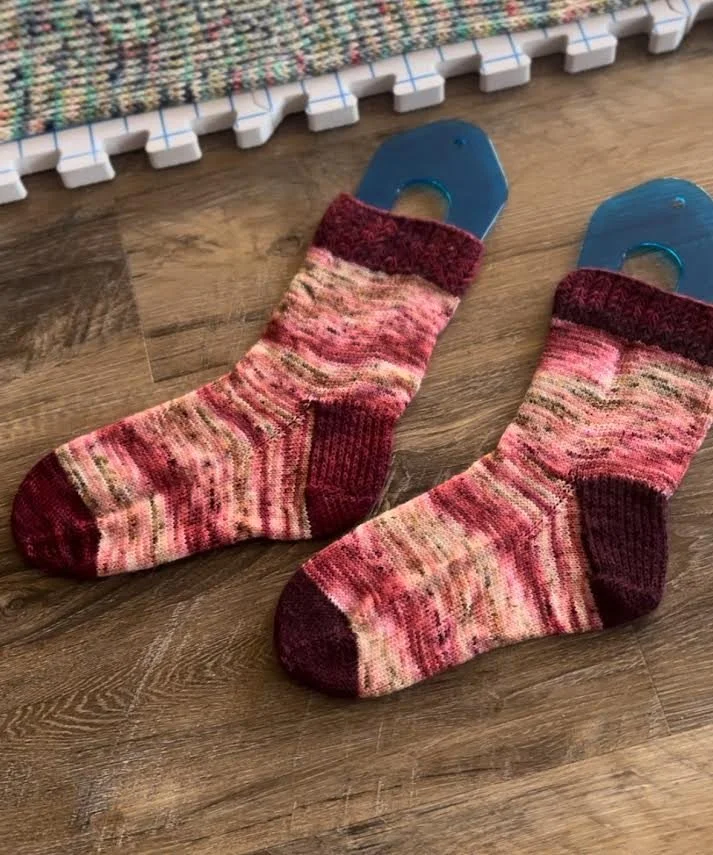
Hand knit socks being blocked on the floor

If you enjoy knitting socks and want something that adds a little visual interest without becoming overly complicated, this series is a really fun one.

The cuff design gives you something new to explore, while the familiar base makes it easy to memorize and knit on the go.

I really enjoyed this project and would absolutely recommend it to other sock knitters.

The Color Cuff Club Volume 2 patterns are available on Ravelry, and it’s a great series if you like building a collection of slightly different socks throughout the year.

Jaunty Shawl by Andrea Mowry: The Perfect Mindful, Memorize-and-Go Knit

Molly Grimm
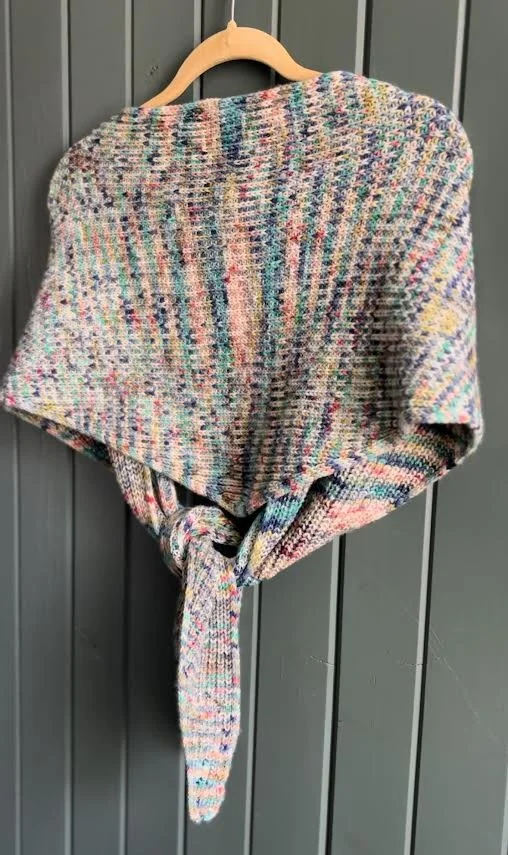
Colorful shawl on hanger

There are projects you knit for the challenge.

And then there are projects you knit because your brain needs something steady.

The Jaunty Shawl falls firmly into the second category.

This is the kind of project you can memorize quickly and take anywhere — a true take-along knit. Once you understand the rhythm, it becomes less about “figuring it out” and more about simply counting rows. Minimal thinking. Maximum flow.

Sometimes that’s exactly what you want from your knitting.

Why I Loved This Knit

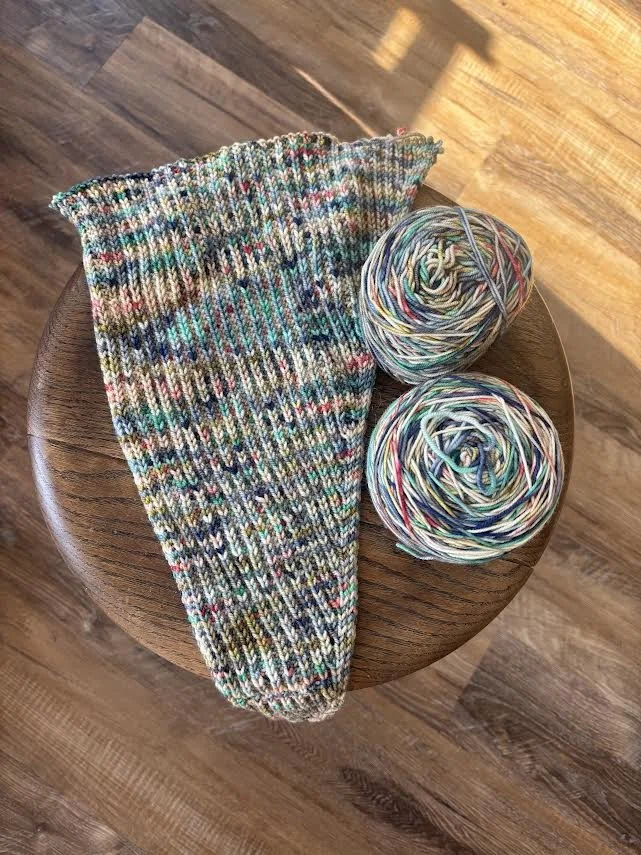
Unfinished knit shawl on stool

The construction is straightforward, intuitive, and incredibly approachable. After the first section or two, I didn’t need to reference the pattern much at all. It became:

Knit.

Count.

Repeat.

Relax.

If you love mindful knitting — where repetition builds focus and steadiness — this project delivers. There’s enough interest to keep it from feeling dull, but not so much complexity that it pulls you out of that calm, rhythmic state.

It’s a beautiful balance.

Yarn Details (And a Yarn Chicken Story)

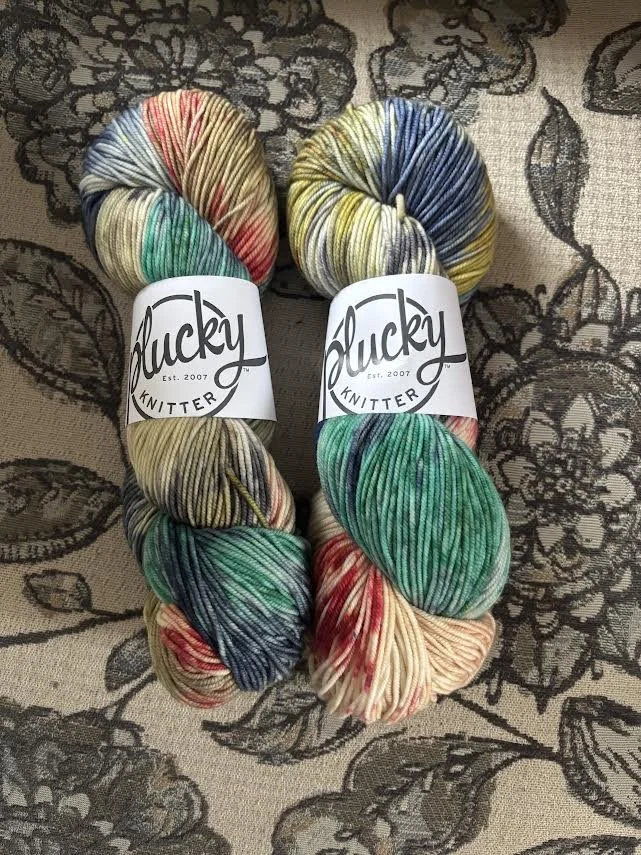
Colorful hanks of yarn

I knit mine in:

Plucky Knitter Legacy Sport Weight

Colorway: Boom Chicka Boom (now discontinued)

This yarn has such a lovely feel — structured but soft, with that classic sport-weight drape that makes shawls wearable without feeling bulky.

And yes… I played yarn chicken.

And yes… I lost.

I was so close to the end that I convinced myself I could make it. I could not. I ended up ordering more yarn to finish the final section — which, thankfully, worked out.

If you’re planning this project, I’d recommend giving yourself a little extra cushion. Especially if you knit on the looser side or want to fully enjoy the experience without watching your yardage every row.

A True Community Favorite

Finished shawl on ground

I know so many knitters who have made the Jaunty Shawl — and loved it. It’s one of those patterns that feels almost universal in its appeal.

It works for:

Confident beginners ready for their first shawl

Intermediate knitters wanting a relaxing knit

Experienced knitters needing a low-pressure project between more technical pieces

It’s engaging without being demanding.

And that’s a rare thing.

Final Thoughts

If you’re looking for a project you can:

Memorize quickly

Knit while traveling

Bring to social knitting

Or simply sink into at the end of the day

The Jaunty Shawl is a wonderful choice.

Sometimes the most satisfying knits aren’t the most complex.

They’re the ones that let you settle in, count your rows, and simply enjoy the rhythm.

And this one does exactly that!

Gentle Hand Stretches for Knitters (To Help Prevent Injury & Support Long-Term Stitching)

Molly GrimmComment

Knitting is calming. It supports the nervous system. It gives our hands something steady to do when life feels loud.

But knitting is also repetitive.

Even mindful knitting asks a lot from your hands, wrists, and forearms. If we want this hobby to last for years — maybe decades — we have to care for the hands that make it possible.

These are the gentle hand stretches I use to support knitting injury prevention and reduce hand fatigue. They’re simple, accessible, and designed to keep your stitching practice sustainable.

You can do them before you knit, during breaks, or after a long session.

Why Hand Care Matters for Knitters

Repetitive motions — even relaxing ones — can create tension over time.

Adding a short hand stretch routine to your knitting practice can help:

* Reduce stiffness and fatigue

* Support wrist mobility

* Improve circulation

* Encourage ergonomic knitting habits

* Protect your ability to knit long-term

Taking care of your hands isn’t dramatic. It’s responsible. And it’s part of knitting for mental health in a sustainable way.


The Hand Stretches

Move slowly. Nothing should feel forced or painful. These are gentle mobility movements — not aggressive stretches.

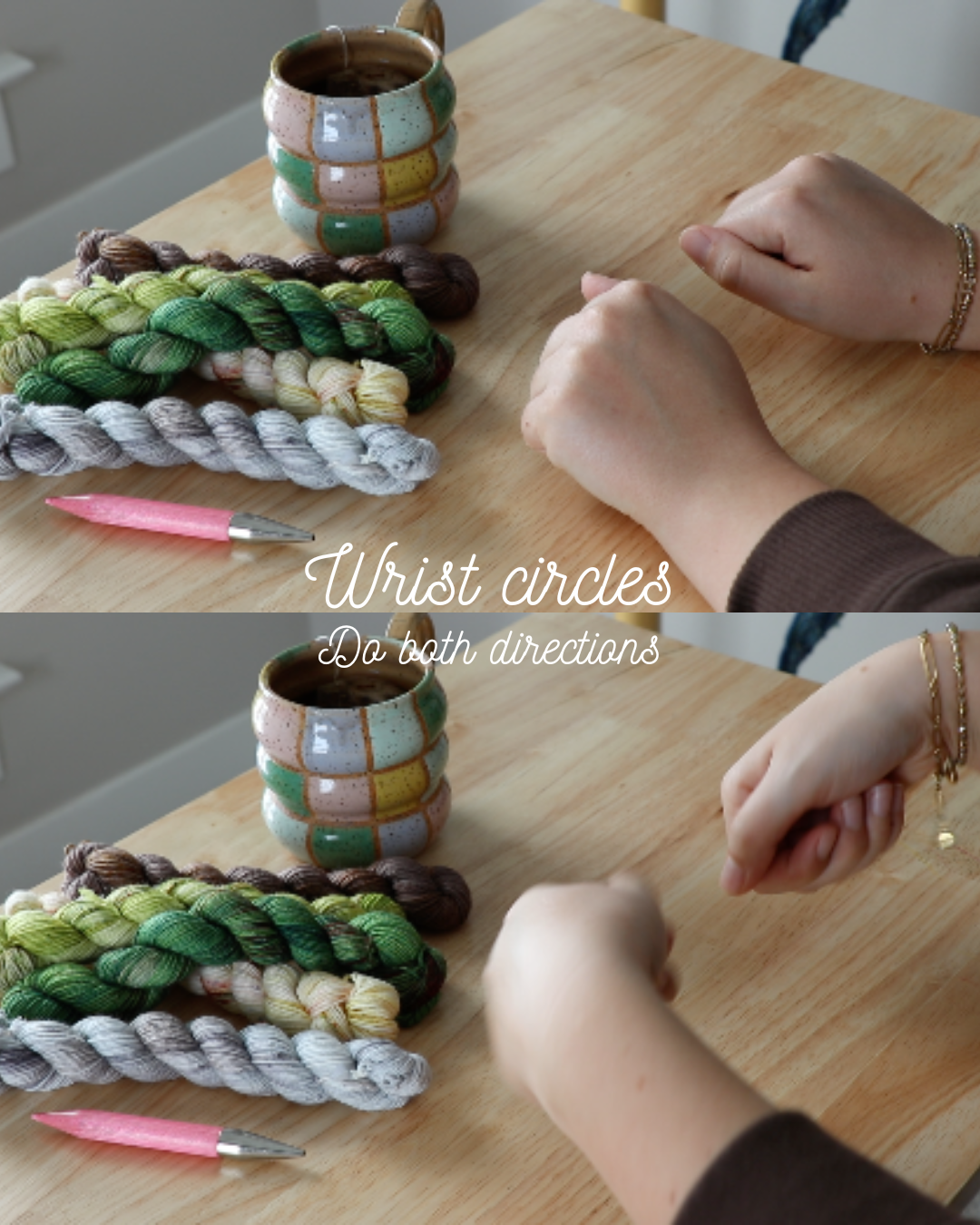
1. Wrist Circles

Photo of wrists rolling in circles as a stretch

Hold your hands out and slowly rotate your wrists in controlled circles. Go one direction for several rounds, then switch.

This helps warm up the joints and improve circulation before repetitive stitching.


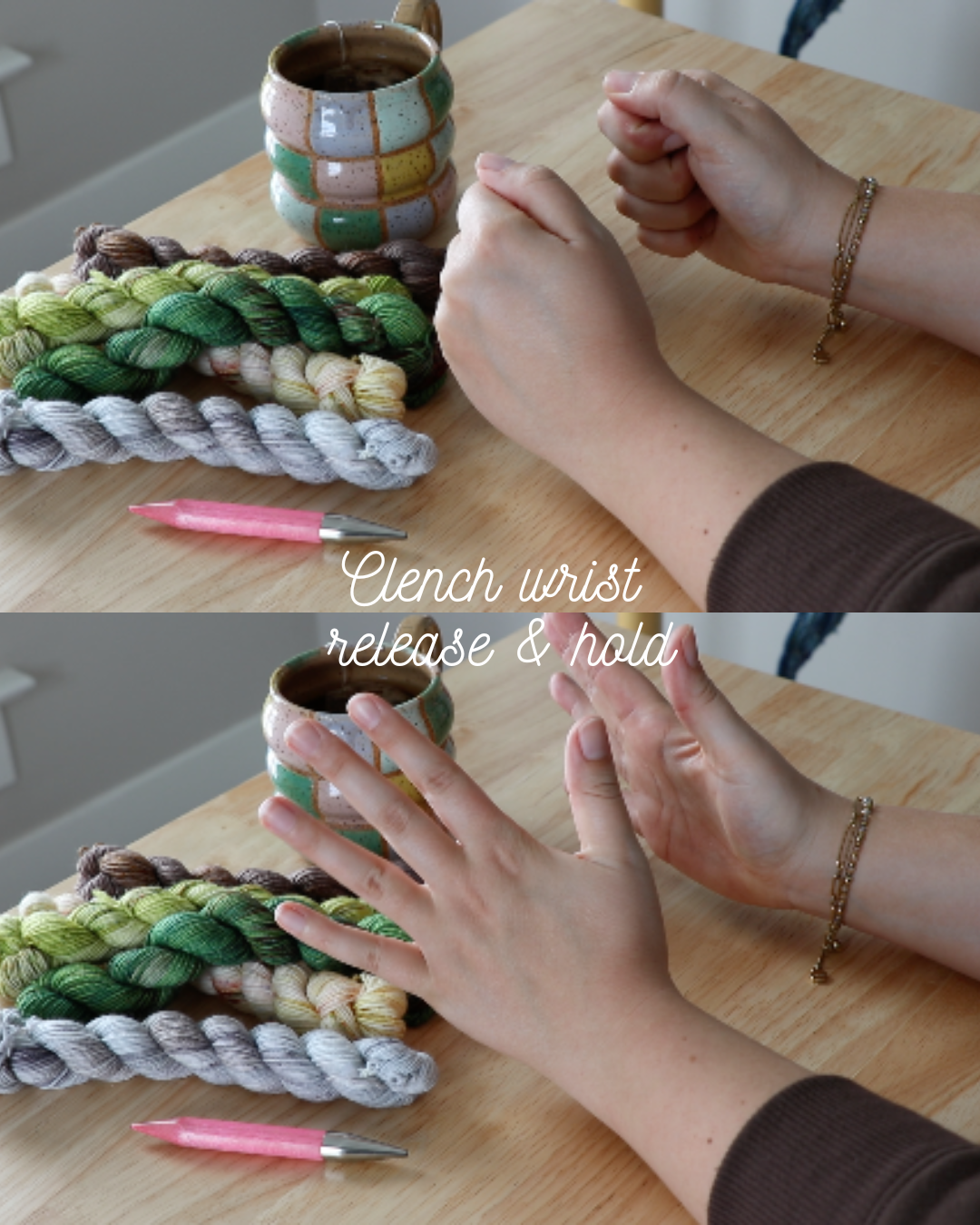
2. Clench & Release

Photo of hands releasing from fisted position

Make a soft fist. Then slowly open your hand and stretch your fingers wide.

Repeat several times.

Most of us hold more tension while knitting than we realize. This helps reset that grip.


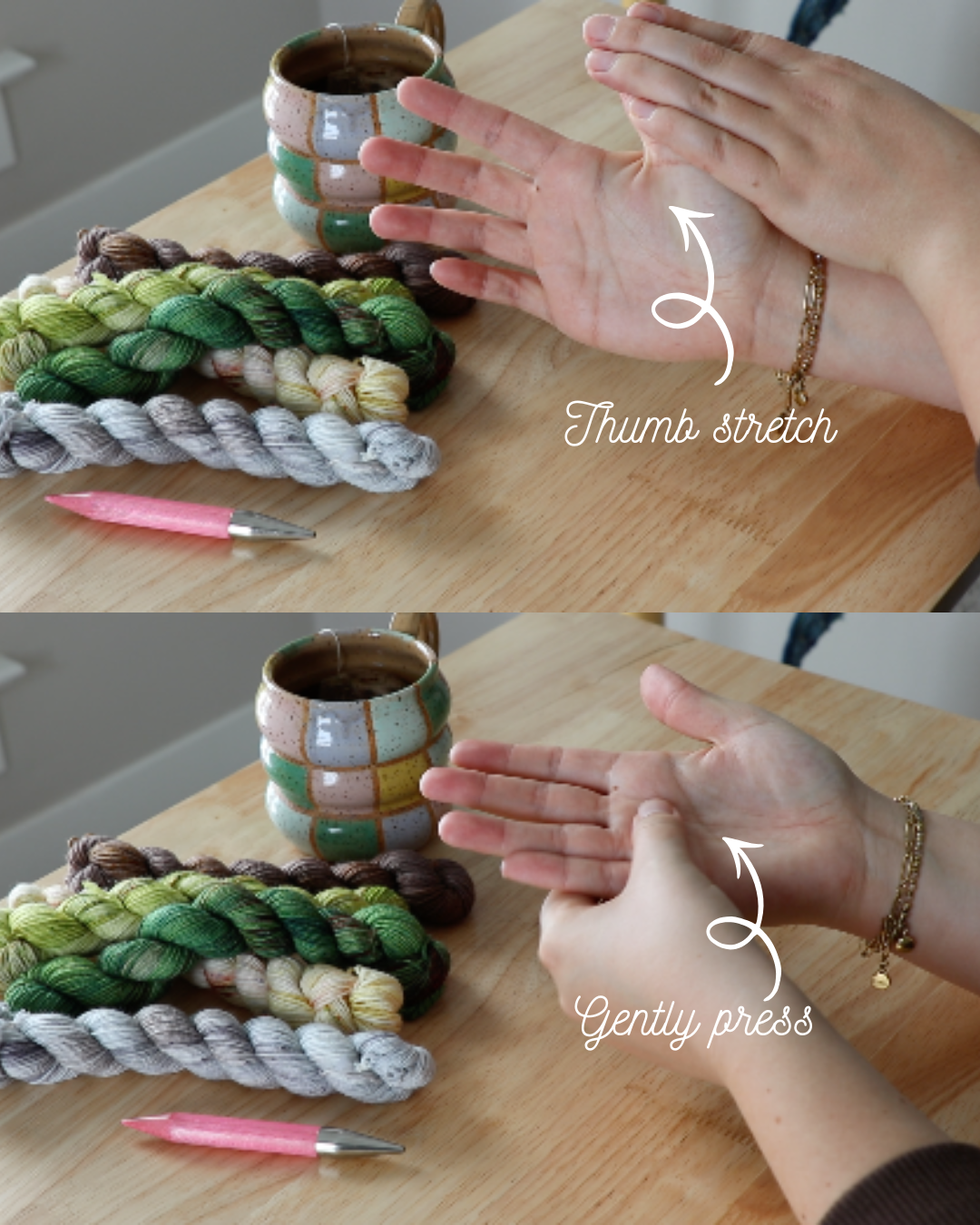
3. Thumb Stretch

Photo of stretching thumb and massaging hand

Gently extend one thumb outward and support it lightly with your opposite hand.

Your thumbs work hard while knitting and crocheting. Supporting their range of motion is important for long-term comfort.

Gently massage each finger and and palm.

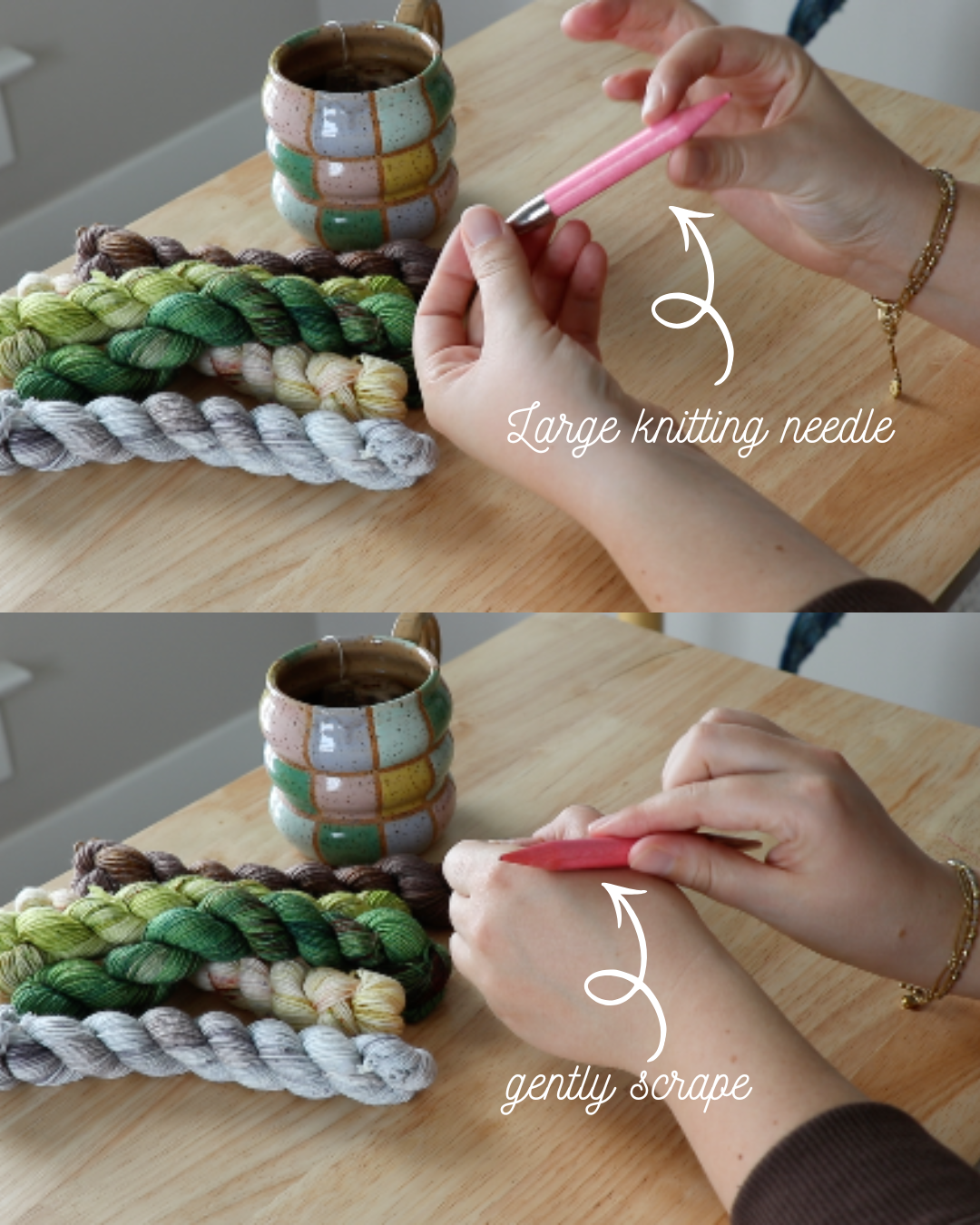
4. Scraping

Photo of a large knitting needle being used to gently scrape or massage hand at thumb area

Gently rub or “scrape” to massage and break up any tension, and improve mobility. Ideally you’d want to use stainless steal, or an actual scraping tool for this. If you don’t have one, you can use a larger knitting needle.

Gently rub the area between thumb and first finger. Do not press that hard, this should not feel painful.

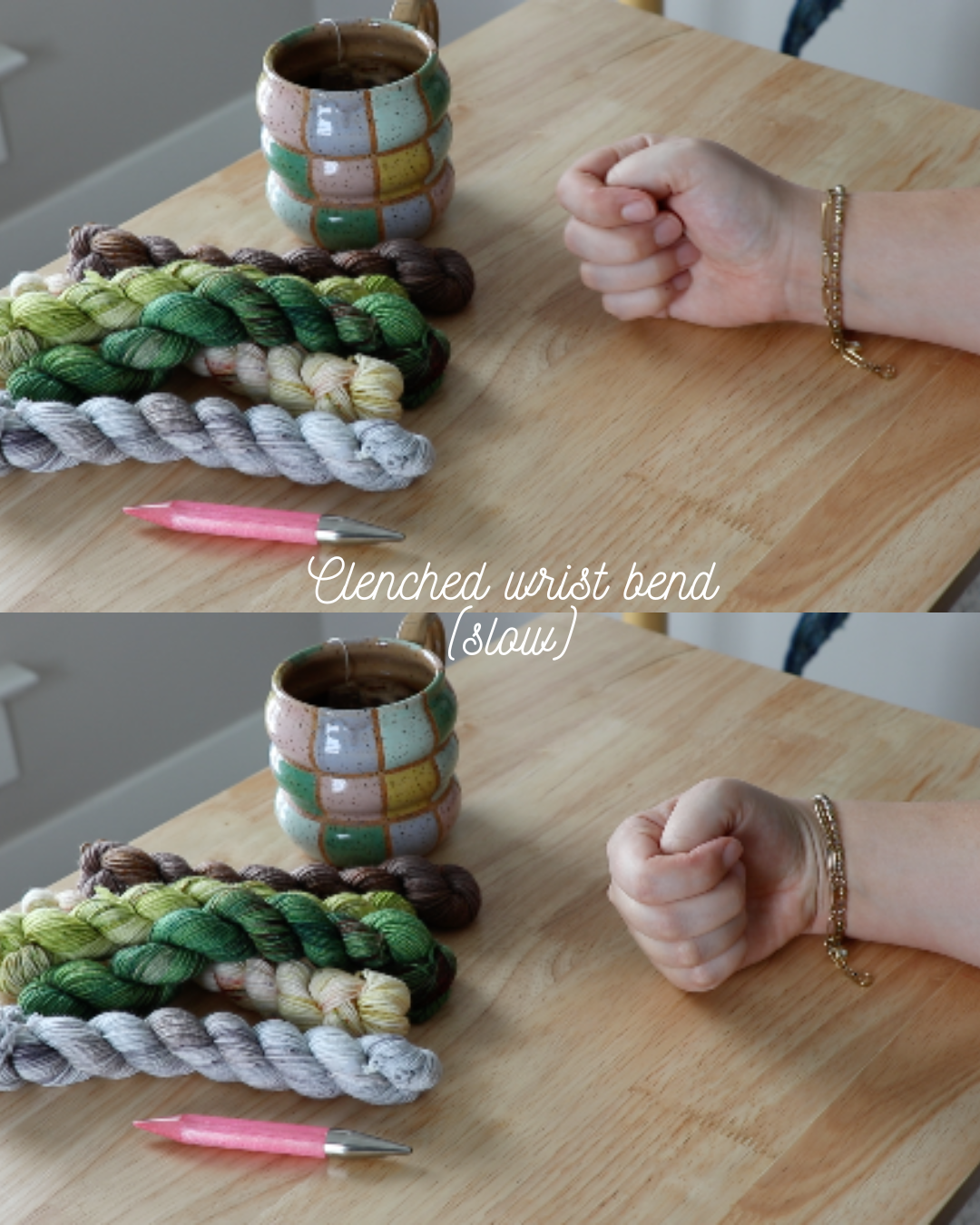
5. Clenched wrist bend

With your arm straight and hand clenched, slowly bend your wrist inward. Return is back to center slowly. Repeat for both hands.

This promotes circulation and awareness without overloading the muscles.

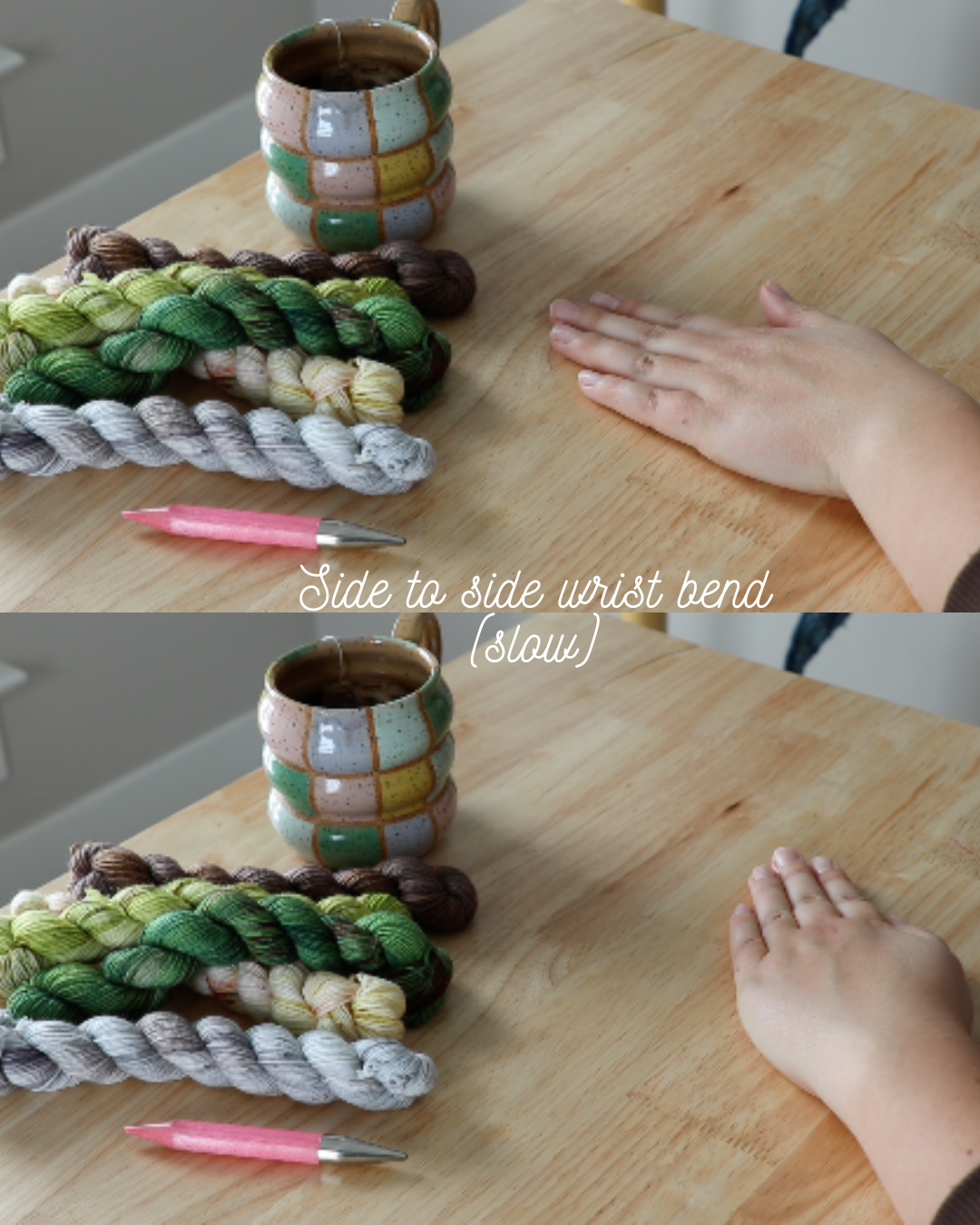
Wrist on table moving from side to side

6. Palm-Down, side to side Wrist Bend

Extend your arm with your palm facing down. Gently guide your hand downward with the opposite hand until you feel a light stretch.

Keep it slow and controlled.

Hand laying flat on table and moving gently from side to side

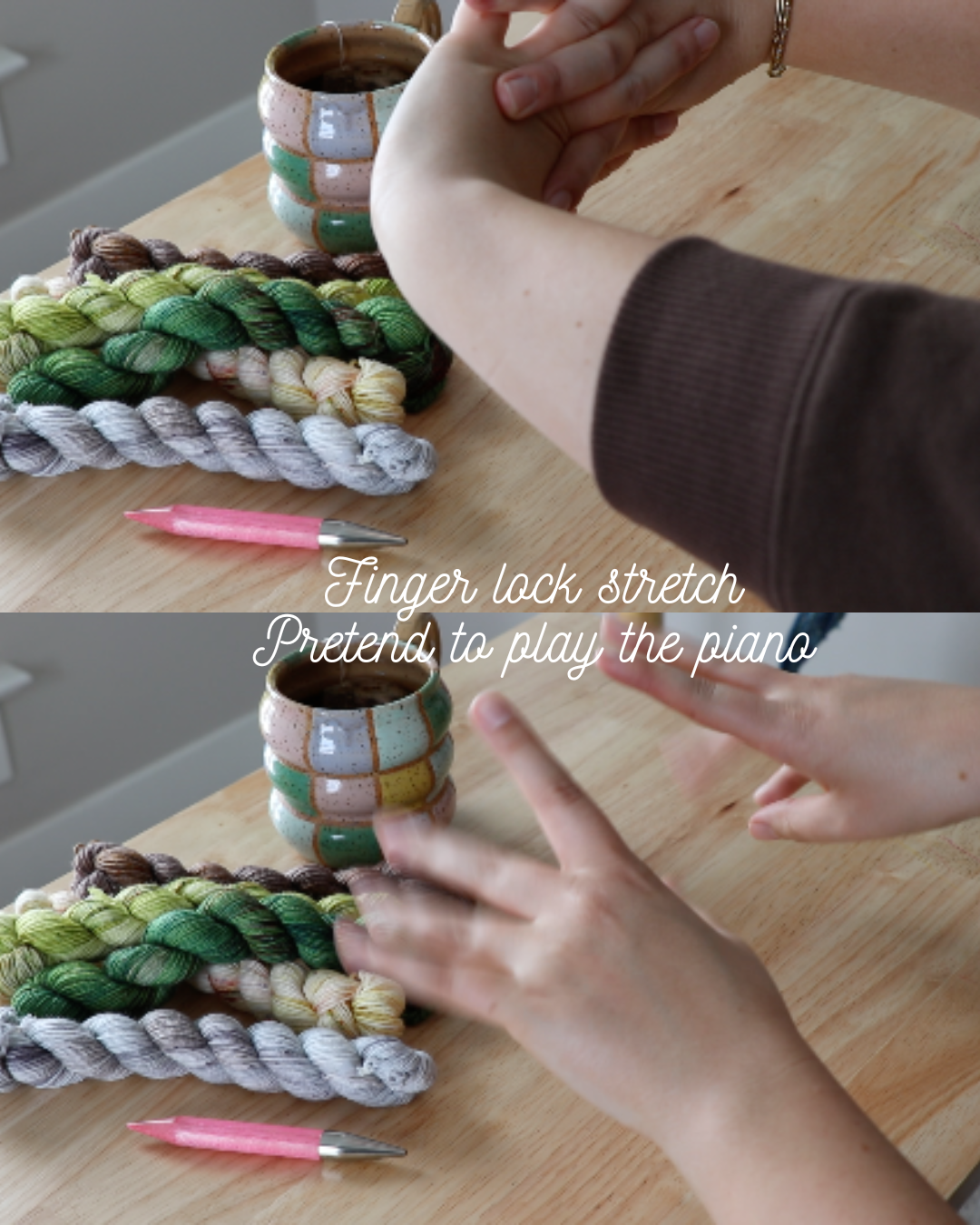
7. Finger Interlace Stretch & Play the piano

Interlace your fingers and extend your arms outward. Gently stretch forward.

Pretend to play the piano and wiggle your fingers.

This helps open the small muscles between the fingers that can tighten during repetitive crafts.

Fingers interlaced and stretching away from body

When to Stop Knitting Instead of Stretching

There’s a difference between mild fatigue and pain.

Some light stiffness that improves with rest can be normal.

But if you experience:

* Sharp or stabbing pain

* Tingling or numbness

* Burning sensations

* Pain that lasts into the next day

* Weakness or difficulty holding needles

Stop stitching and seek care from a healthcare professional right away.

I am not a doctor. This is simply the hand stretch routine I use to support my own knitting practice. If you are experiencing pain or injury, please consult a licensed healthcare provider.


Knitting Wellness Includes Physical Care

Mindful knitting isn’t just about slowing down mentally. It’s about supporting your body so you can continue doing what you love.

Rest isn’t quitting.

Stretching isn’t overreacting.

Caring for your hands is how this hobby lasts.

Here is a video I made demonstrating all the movements mentioned above:

Save this routine. Come back to it. Share it with someone who loves to stitch.

Your hands matter!

Knitting Tools I Use for Nearly Every Project (From Start to Finish)

Molly Grimm

This post may contain affiliate links. I may earn a small commission at no additional cost to you.

One of the questions I get asked most often through Knitting Wellness is about tools. Not the trendy ones or the ones that look good on a shelf - but the knitting tools I actually use over and over again.

This post walks through my go‑to knitting tools from start to finish, the ones I reach for on nearly every project. These are tools that support a calm, steady knitting process and make projects feel easier rather than more complicated.

If you’re looking for essential knitting tools, beginner-friendly knitting supplies, or simply want to simplify your setup, this list is a great place to start.

Why Tools Matter for Mindful Knitting

The right tools don’t make you a better knitter - but they do remove friction. When tools are reliable and familiar, your attention can stay on the rhythm of knitting rather than problem-solving.

Everything on this list earns its place because it supports ease, comfort, and consistency.

1. My Go-To Yarn

While I enjoy trying new yarns, I always come back to a few reliable bases that feel good in my hands and hold up well over time. I look for yarn that:

Feels smooth without being slippery

Has good stitch definition

Is versatile enough for garments, accessories, and everyday projects

Having a dependable “default” yarn removes a big decision at the start of a project and helps knitting feel approachable rather than overwhelming.

Here are my two recommendations:

Malabrigo (any weight) and The Rambler by Woolly Thistle (light fingering/sock weight)

Malabrigo has a lot of soft superwash wool options, while The Rambler is a bit more rustic and “woolly”.

Photos of yarn

Malabrigo

Photo of green and white yarn

The Rambler

2. Yarn Ball Winder

A yarn winder is one of the most-used tools in my knitting space. It turns hanks into neat, center-pull cakes that are easy to store and use.

Why I rely on it:

Saves time at the beginning of a project

Keeps yarn organized

Makes knitting feel calmer and less tangled

This is a tool I use on almost every project before I even cast on.

This ball winder was a hand-me-down gift from my husband’s grandmother. It’s on it’s last leg, but if you’re just starting out, this winder is perfect. There are also electric winders, and larger options, however, this one does the trick for me!

3. Yarn Swift

A swift works hand-in-hand with a yarn winder. It holds the hank open and stable while winding, making the process smooth and frustration-free.

Together, a swift and winder turn yarn prep into a quiet ritual rather than a chore.

My husband got my winder as a birthday gift almost 7 years ago! This particular one is no longer sold, however, I’ve linked one from JBW here that would be similar.

4. Knitting Needles I Reach For Again and Again

I tend to gravitate toward the same style of needles for most projects. Comfort matters more to me than novelty.

I look for needles that:

Feel comfortable in my hands

Have smooth joins

Allow stitches to move easily without slipping off

Using familiar needles reduces hand strain and keeps knitting enjoyable for longer sessions.

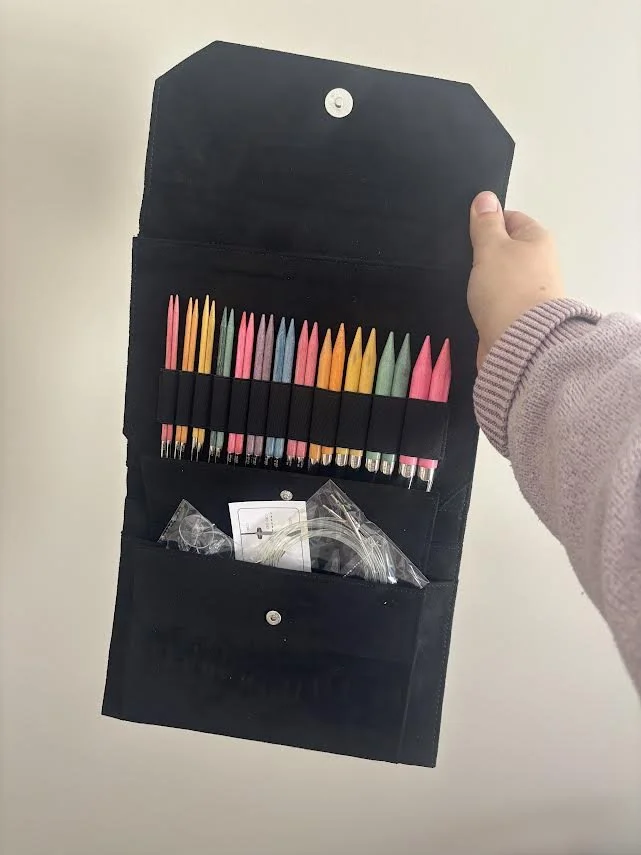
I like to keep an interchangeable metal set (Knit Pro Affection) and a wooden set (LYKKE) for different projects.

If I’m buying one off needles that aren’t apart of a set, I prefer Chiaogoo. I find these are also available at most yarn shops!

Interchangable knitting needle set

KnitPro Mindful Collection Needle Sets - Affection

Colorful interchangeable knitting needle set

LYKKE Crafts Birchwood Interchangeable Needle Sets - Colour - Black Case - 5" Tips US 4-17

5. Small Tools That Make a Big Difference

These little tools live in nearly every project bag:

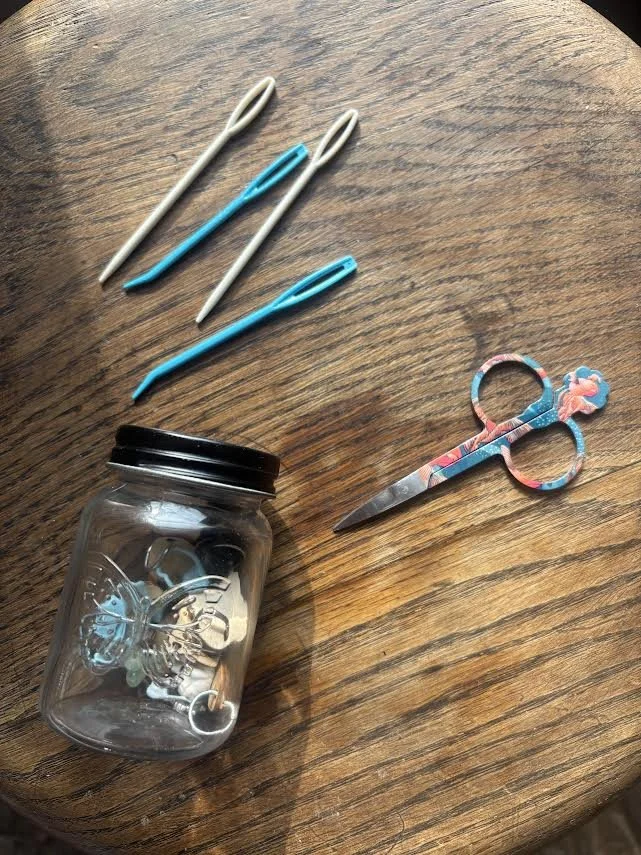
Darning needle (for weaving in ends)

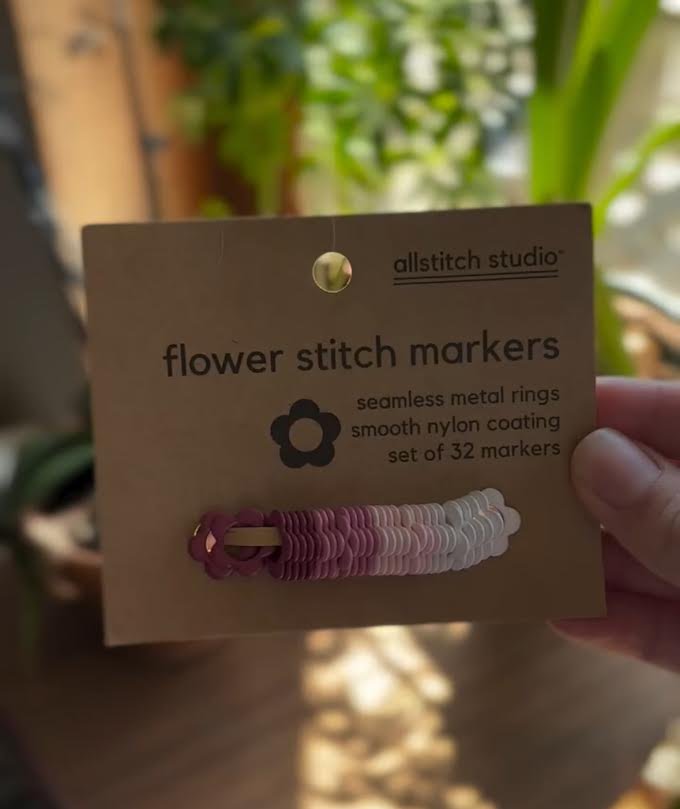
Stitch markers (simple and easy to see) - my favorite are these Lantern Moon Stitch Markers. I love using these especially for thinner weights of yarn because they don’t snag or slide!

Scissors or yarn cutter - my scissors are sold out online, however here is a similar pair!

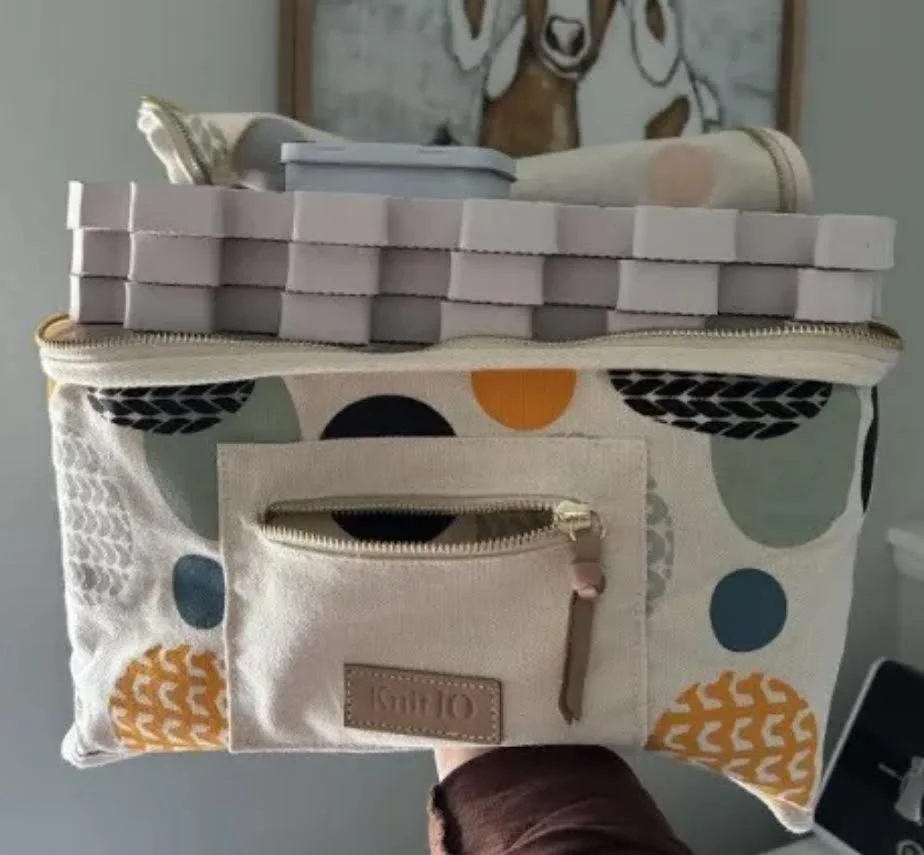
Small jar or bag for accessories - I found this little jar while thrifting! You can really use anything to hold all the small items. I just take this with me in my project bag.

These items are small, inexpensive, and absolutely essential - especially when you want to avoid hunting for tools mid-project.


6. Project Bags

A good project bag keeps knitting portable and protected. I like bags that:

Hold the project comfortably without cramming

Keep tools together

Are easy to grab and take with me

Having a dedicated bag for each project helps keep my knitting organized and my mind clear.

I almost exclusively use these Della Q project bags! They are made with knitters in mind. These bags have maker specific features like a yarn feeder, yarn cutter, and a decorative pin with emergency stitch markers. Many of them can be worn multiple ways.

7. Blocking Tools: From Soak to Finish

Blocking is part of finishing a project, and having simple, reliable tools makes a big difference.

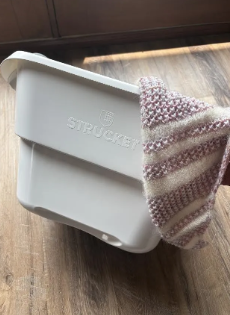
Strucket Bucket

I use a flexible bucket for soaking and washing knits. It’s sturdy, easy to move, and stores neatly when not in use. We live on a rural farm in Indiana. Our sink gets used a lot for various things (like cleaning hundreds of chicken eggs!) Our kitchen sink gets cleaned daily, but I love having this bucket to use specifically for hand knits. You can hand agitate, and the water releases from a plug at the bottom. It’s very handy!

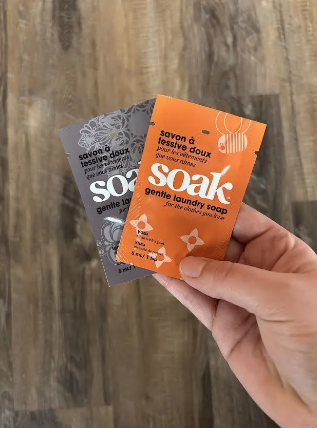
Wool Wash

My favorite wool wash to use is Soak. They are individual packets of gentle laundry soap designed specifically for wool and knitting projects. I haven’t found a scent that I don’t love from them!


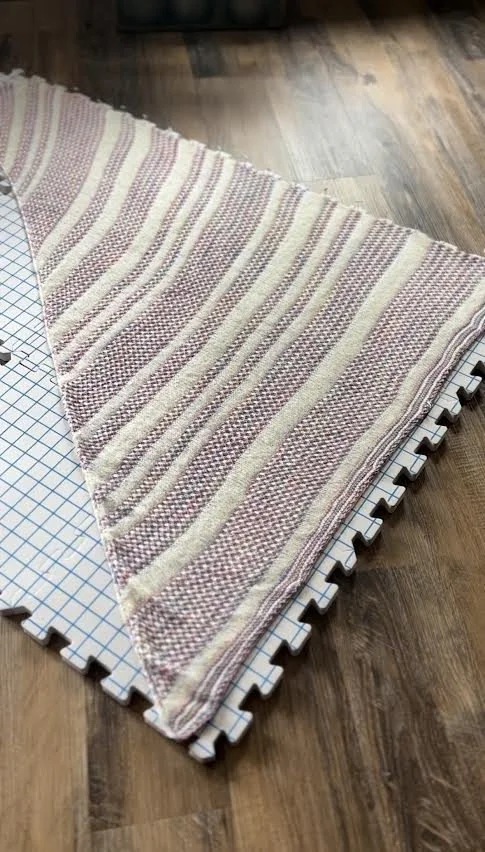
Blocking Mats

Blocking mats provide a flat, stable surface for shaping projects. They’re especially helpful for garments, shawls, and accessories that benefit from gentle shaping. The blocking mats I used are sold out, however, here’s a link to a similar set here!

Final Thoughts

Knitting doesn’t require endless tools - just a few dependable ones that support your process from cast-on to finishing.

These are the knitting tools I return to again and again because they make knitting feel steady, comfortable, and enjoyable. Whether you’re just starting out or refining your setup, building a small collection of reliable tools can make a meaningful difference in how knitting feels.

Affiliate Disclosure: This post may contain affiliate links. If you choose to purchase through these links, I may earn a small commission at no additional cost to you. I only share tools and supplies I genuinely use and enjoy. Thank you for supporting Knitting Wellness.

Finished Project: Cozy Socks by Summer Lee

Molly Grimm

There’s something especially satisfying about finally casting off a project that’s been waiting patiently in your stash - and these socks feel extra meaningful for that reason.

This pair was knit using yarn I purchased two years ago at the Michigan Fiber Festival from the Yarnbyrds yarn truck. It’s always fun (and a little nostalgic) to work with yarn that has a story attached to it, and this project felt like the perfect opportunity to finally put this skein to use.

The Pattern: Cuff Club Socks by Summer Lee (Volume 2)

This sock pattern by Summer Lee is one of those designs that feels thoughtful without being complicated. The construction is intuitive, the fit is comfortable, and the details keep the knitting interesting without requiring constant focus.

It’s the kind of sock pattern that works beautifully for mindful knitting - engaging enough to enjoy, but simple enough to relax into.

Why I loved this pattern:

Clear, easy-to-follow instructions

A comfortable, wearable sock fit

Interesting details without feeling fussy

Perfect for slowing down and enjoying the process


Colorful handknit socks

The Yarn: Spun Right Round Tough Sock Set (discontinued in this colorway, but there’s many beautiful options on their website - not affiliated, but I would highly recommend!)

This yarn has been in my stash for a while, and I’m so glad I waited for the right project.

The Tough Sock base is exactly what you want for socks - sturdy, smooth, and pleasant to knit with. It held its shape beautifully throughout the project and feels durable without being stiff.

Colorful sock yarn set

Sock knitting has always felt grounding to me. The small circumference, repetitive motion, and steady progress make it an ideal project for slowing down and staying present.

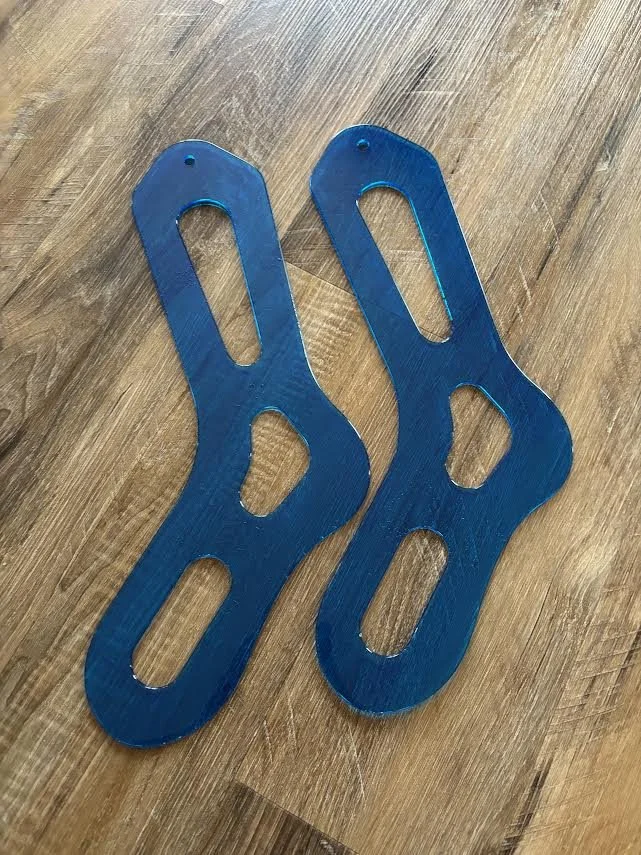
For finishing this pair, I used Knit Picks plastic sock blockers, which have quickly become my personal favorite. I’ve used metal and wooden sock blockers in the past, but I consistently reach for the plastic ones.

Final Thoughts

Finishing these socks felt like finishing a project using a yarn from a fiber festival years ago, paired with a pattern that encourages steady, mindful knitting. They’re comfortable, wearable, and full of memory, which is exactly what I hope for in a handmade project.

If you enjoy sock knitting for relaxation, grounding, or simply the joy of finishing something small and useful, this pattern and yarn combination is one I’d happily recommend.

Affiliate Disclosure: This post may contain affiliate links. If you choose to purchase through these links, I may earn a small commission at no additional cost to you. I only share yarns, patterns, and tools I genuinely enjoy and use. Thank you for supporting Knitting Wellness.

This Year, in Yarn

Molly Grimm

This post may contain affiliate links. I may earn a small commission at no additional cost to you.

A look back at the yarns that shaped my knitting in 2025 -


Knitting doesn’t really show up as timelines. It’s textures, weights, colors, and the quiet familiarity of yarn passing through your hands.


When I looked back at my projects from 2025, what stood out most was which yarns kept showing up, and how differently they met me in different seasons.


Some were chosen for comfort, some for structure, and some because they felt right for where I was at the time.


This post is a simple look back at every yarn I used in 2025, the projects they became, and a few notes on why they worked so well. If you’re planning future knits or enjoy seeing how yarn behaves in real life (not just on a label), I hope this feels helpful.


Why I Pay Attention to Yarn Choice

For me, knitting has always been about more than the finished piece.

The feel of the yarn, how it moves, how forgiving it is on tired hands - all of that matters.


In knitting therapy and mindful knitting, the materials we use can support:


  • slower pacing

  • nervous system regulation

  • sustained focus

  • enjoyment without pressure


The yarn doesn’t need to be perfect, but it does need to work with you.


The Yarns I Used in 2025

Below is a full list of the yarns I knit with this year, along with the projects they became and a few honest notes from my experience.


Spincycle Dyed in the Wool - Sport Weight

5 colorful hanks of yarn on a stool
Colorful hand knit shawl
5 colorful hanks of yarn


Fiber content: 100% superwashed American wool

Weight: Sport (Note - Original Nightshift pattern calls for worsted)

Colors Used: Rosy Maple, Rusted Rainbow, Salty Dog, Shades of Earth, Melancholia, Deep Bump

Project(s): Nightshift by Andrea Mowry

Notes: I subbed Sport weight for this project, and was so happy with the end result! I alternated this yarn. There was also an additional hank “Deep Bump” which is not pictured above.

This yarn worked especially well for unexpected color! I loved it for the surprise, and would reach for it again when I want a creative fade within a colorwork project.

Here’s the link to where I purchased mine

*Please note if this retailer is sold out, you can email them your order instead! They should be able to get more in for you. Just let them know Knitting Wellness recommended it :)


Malabrigo Arroyo & Blue Sky Prarie

Pink and white hanks of yarn
Pink and white shawl


Fiber content:

Arroyo - 100% Superwash Merino Wool

Prairie - 53% Suri Alpaca, 47% Baby Huacaya Alpaca

Weight:

Arroyo - Sport

Prairie - Fingering

Colors:

Arroyo - White (1), Rosalinda (1)

Prairie - Yarrow (1)

Project(s): Alpine Shawl by Knit Sisu

Notes: These two yarns were alternated throughout the pattern using the bee stitch. It was a fun knit with lots of texture!

This one surprised me. It felt relaxing on the needles and held up beautifully after blocking.


Click here to purchase Blue Sky Prairie

Click here to purchase Malabrigo Arroyo

*Please note if this retailer is sold out, you can email them your order instead! They should be able to get more in for you. Just let them know Knitting Wellness recommended it :)


Catskill Merino

Green and pink yarn
Picture of cowl with fish details

Fiber content: Merino Wool

Weight: Sport, although this one acts more like a DK

Colors: Wintergreen & Pink Sand

Project(s): Halibut Cowl by Caitlyn Hunter

Notes: This yarn is farm fresh - you may find bits of “breakfast” in it :). It’s super squishy, soft, and the bloom after blocking is the best!

A steady, reliable yarn - especially good for colorwork. This is one I’d recommend for knitters who value small batch yarns.

Click here to purchase Catskill Merino


LITLG & Island Dyeworks

Toddler hand knit cardigan with bow
pink
pink mohair yarn

Fiber content:

LITLG: 75% superwash merino wool, 25% nylon

Island Dyeworks: Mohair

Weight:

LITLG: Sock yarn

Island Dyeworks: Lace

Colors:

LITLG: Wild Rosebay

Island Dyeworks: Light Pink

Project(s): Audrey Cardigan (Toddler) by Knitting for Olive

Notes: This combo held together was an unexpected surprise! Island Dyeworks is located in Saint Simon Isalnd - I received this lace weight as a gift from my Mom. They don’t have a website, but they can ship orders out from the island by phone call. Ask for Beau, she hand dyes this mohair and it’s the best I’ve found!

Click here to purchase LITLG Wild Rosebay


Ewe2Yarn & Island Dyeworks

pink and red yarn with shawl

Fiber content:

Ewe2Yarn: Discontinued (was a specialty color for Nashville Yarn Festival called Nashville Red!)

Island Dyeworks: Mohair

Weight:

Ewe2Yarn: Aran

Island Dyeworks: Lace

Colors:

Island Dyeworks: Light Pink

Project(s): Redware Pattern by Catie Robbins

Notes: I used leftover mohair from Island Dyeworks for this scarf, see the note above for this yarn! This was a fun intarsia pattern that can be worked with multiple colors.


Scheepjes Woolwise & Kindsom

pink and white balls of yarn
green and blue balls of yarn
Colorful hand knit socks
hand knit hat with flower pattern

Fiber content:

Woolwise: 100% Superwash Merino Wool

Kindsom: 60% Wool, 40% compostable polyester

Weight:

Woolwise: Fingering

Kindsom: Sport

Colors:

Woolwise: Orchid Pink, Petal Pink, Floral Pink

Kindsom: Deep Ocean & Seedling

Project(s): Flower Power Beanie by Stone Knits, Thulite Socks by Allison Lutes

Notes: This was a gifted collaboration with Scheepjes Yarn. The yarn was nice to work with, durable, and definitely an affordable option. There are several colors to choose from, which I appreciated.

Click here to view Scheepjes Yarn


Spincycle Wilder & Dyed in the Wool

colorful yarn
colorful hand knit sweater

Fiber content:

Wilder: 100% Non-Superwash Rambouillet Wool

Dyed in the Wool: 100% American Wool

Weight:

Sport

Colors:

Wilder: Light Gray

Dyed in the Wool: Ghost Ranch

Project(s): Ooey Gooey Sweater by Andrea Mowry

Notes: This was my all time favorite project of 2025! The yarn, the pattern, the colors - everything about this knit was enjoyable from start to finish!

Yarn purchased at Knitting off Broadway in Fort Wayne, Indiana


Spincycle Wilder & Dyed in the Wool

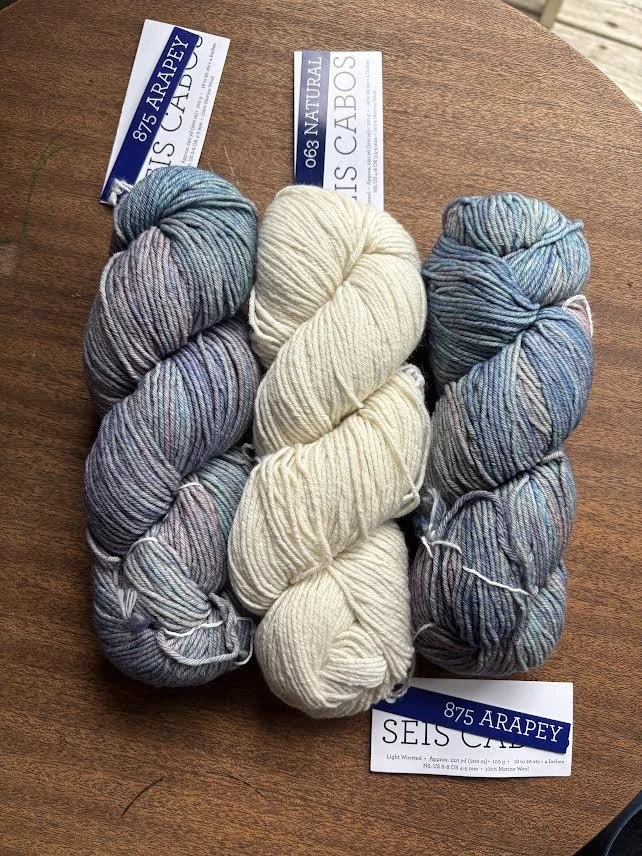
blue and white yarn
blue and white shawl with drape

Fiber content: 100% Superfine Merino Wool

Weight: Light Worsted

Colors: Arapey & Natural

Project(s): Barnstable by Lisa Hannes

Notes: This was part of the Malabrigo KAL. The mosaic texture was fun to make with the different contrasting colors. This yarn blocked beautifully when finished, and had a great drape to it!

Purchase Malabrigo Seis Cabos here

Malabrigo Mecha

pink and purple yarn on table with coffee

Fiber content: 100% Pure Merino Superwash Wool

Weight: Bulky

Colors: Rosalinda & English Rose

Project(s): Chubby Butterflies Hat by Joji Locatelli

Notes: I’ve had leftover Mecha for a long time! I ordered the Rosalinda to go with my stash of English Rose. This was a short hat project for my youngest daughter. It knit up very quickly. Mecha is extremely soft, and the colors are vibrant.

Purchase Malabrigo Mecha Here


Lopi Lettlopi

orange and yellow yarn
orange and yellow cowl with fish design

Fiber content: 100% Icelandic Wool

Weight: Medium/Worsted

Colors: Apricot & Mimosa

Project(s): Halibut Cowl by Caitlyn Hunter

Notes: I loved this project so much - I had to cast on another one! This yarn is very woolly. It worked well for what I was going for. Compared to the other cowl I made, this one doesn’t have as much stitch definition. However, there is a great variety of color options. Would highly recommend!

Click here to purchase Lopi Lettlopi


Sandnes Garn Double Sunday

pink yarn
young girl doing a puzzle with pink sweater vest hand knit

Fiber content: 100% Merino Wool

Weight: DK

Colors: Bubblegum Pink

Project(s): Lulu Slipover Jr. by Petite Knit

Notes: This was a sweet project I got to make for my oldest daughter. I loved the yarn, it has great stitch definition, and is extremely durable (great for kids!). I was able to get the exact gauge as the pattern, which I was pretty excited about. This is a great affordable yarn that also has quality.

Click here to purchase Sandnes Garn Double Sunday


JA Devonia DK

single hank of green yarn
green and pink floral cowl

Fiber content: 50% Exmoor Blueface Wool, 30% Bluefaced Leicester Wool, 20% Wensleydale Wool

Weight: DK

Colors: Ivy Leaf & Broken Flower (not pictured)

Project(s): Pressed Flowers Cowl by Amy Cristoffers

Notes: I loved this project so much - I had to cast on another one! This yarn is very woolly. It worked well for what I was going for. Compared to the other cowl I made, this one doesn’t have as much stitch definition. However, there is a great variety of color options. Would highly recommend!

Yarn Purcahsed at Simply Socks Yarn Company


If You’re Planning Your Own Knits

If you’re choosing yarn for an upcoming project, my biggest encouragement is this:

Choose yarn that supports how you want to knit - not just what you want to make.

Whether that’s knitting for stress relief, mindful crafting, or simply carving out a quiet corner of your day, the right yarn can make the process feel steadier and more kind.

Affiliate Disclosure

Some, not all, links in this post are affiliate links, which means I may earn a small commission if you choose to purchase through them - at no extra cost to you. I only share yarns I’ve personally used and enjoyed as part of my knitting practice.

Lulu Slipover Jr. - A Sweet Finished Knit

Molly GrimmComment

This post may contain affiliate links. I may earn a small commission at no additional cost to you.

The Lulu Slipover Jr. by PetiteKnit was one of those projects that reminded me why I love knitting for my kids so much.

I knit a size 7–8 years using Sandnes Garn Double Sunday in the sweetest bubblegum pink - a color that feels absolutely perfect for Valentine’s Day. The pattern itself was a delightful knit: thoughtful construction, clear instructions, and just enough interest to keep things engaging without being complicated.

This project does come with a little real-life twist. I actually had to tear it out once because my daughter grew before I finished it (a very real knitter-parent problem). Thankfully, the second time around it came together beautifully - and now it fits her perfectly.

The finished slipover is cozy without being bulky, polished yet playful, and easy to layer over dresses or long-sleeve tops. It’s the kind of handmade piece that will get worn again and again - which always feels like a win.

Project Details

Pattern: Lulu Slipover Jr. by PetiteKnit

Yarn: Sandnes Garn Double Sunday

Color: Bubblegum Pink

Size Knit: 7–8 years

Needles

Buttons

If you enjoy knitting garments for children and want a pattern that’s both timeless and practical, this one is absolutely worth adding to your queue.

On Effort: What Makes Something Meaningful (and What Doesn’t)

Molly GrimmComment

After the rush of the holiday season, one word kept returning to me: effort.

Not necessarily productivity, hustle or doing more.

Just effort.

I started noticing it everywhere - in homes, displays, gatherings, handmade gifts, traditions carried forward year after year. Someone put effort here. Paid or unpaid. Visible or invisible. Intentional or automatic.

And it made me wonder:

How much effort does something actually require before it becomes meaningful?

Is effort required at all?

We often assume effort and meaning are tightly linked. That if something mattered, it must have taken a lot of energy. That if we didn’t push ourselves, we didn’t “really” show up.

But when I look closer, that story doesn’t always hold.

Effort vs. Meaning

In knitting, this shows up clearly.

Some people finished three projects this year. Others finished twenty-five. On paper, the effort looks wildly different. But does that automatically mean the meaning is different?

Not necessarily.

A simple scarf worked slowly, intentionally, during a difficult season can carry more weight than a dozen finished objects made during a time of ease. The effort isn’t just in the quantity or complexity - it’s in how present we were while making.

Meaning doesn’t scale linearly with output.

The Invisible Effort We Don’t Talk About

When I think about holidays, some hosts pour themselves out: cooking, planning, remembering details, managing emotions, holding traditions together with sheer will. Others seem to thrive - not because they care less, but because their effort aligns better with their energy, resources, and season of life.

The difference isn’t commitment, but possibly where the effort is coming from.

Effort that comes from depletion feels heavy.

Effort that comes from alignment feels alive.

When Effort and Energy Don’t Match

This is the question I keep circling back to:

What happens when we keep applying effort that doesn’t match our energy?

Sometimes the outcome looks the same from the outside - the project gets finished, the meal gets served, the obligation gets met. But internally, the cost is different.

When effort consistently outpaces energy, resentment creeps in. Joy thins out. Even beautiful things begin to feel hollow.

That doesn’t mean effort is bad. Perhaps means effort needs context.

Is the Effort in Preparation - or Something Else?

We often assume effort lives in preparation: planning, organizing, anticipating what’s next.

But preparation alone doesn’t always make something feel good.

Sometimes the effort that matters most is quieter:

  • Choosing presence over perfection

  • Staying with something instead of rushing past it

  • Allowing “enough” to actually be enough

In knitting, this might look like returning to the same simple pattern again and again - not because it’s impressive, but because it steadies you. The effort isn’t in learning something new; it’s in showing up consistently.

A Different Intention for the Year Ahead

As I look toward 2026, I don’t want to put more effort into everything.

I want to put more effort into the little things - not from pressure, but from choice. Not to produce more, but to feel more alive and aligned inside the life I’m already living.

Less reacting, less chasing the “big feeling”, and way more intention in the ordinary moments that already exist.

Knitting reminds me of this again and again: meaning isn’t made by forcing effort - it’s shaped by how we relate to what’s already in our hands.

On beginnings, endings,and the quiet in between

Molly GrimmComment

Knitting has always felt a little like following a recipe.

If you understand the basics — how to knit, how to read a pattern — everything you need is laid out in front of you. The ingredients are measured. The steps are clear. And unless there’s a new-to-you technique, there’s very little extra brain power required. Flow comes easily.

Our brains love that. They’re wired to conserve energy whenever possible —

favoring familiar rhythms and predictable patterns, where less effort is required and more presence becomes available.

And yet, even a small challenge — a new stitch, a different construction — can feel welcome. There’s something deeply satisfying about learning just enough to stretch us, then completing it. A quiet sense of self-sufficiency. A small, earned pride.

In that way, knitting also feels a bit like reading a good book.

When you’re in the middle of a familiar pattern, there’s comfort in knowing what comes next. The next ten rows will be this. The next few inches will be that. Even if everything else in life feels uncertain, the pattern offers a sense of order and predictability. Control, in the gentlest sense.

So why does starting a new project feel so hopeful — while finishing one often feels strangely quiet?

Beginnings are full of possibility. Especially for those of us who tend to dream. New yarn, new colors, new ideas. The “what-ifs” feel endless, and most of them are good. We imagine the finished piece, yes — but also the version of ourselves who will wear it, use it, live alongside it.

As the project unfolds, reality settles in. There are tricky sections. Mistakes that require ripping back. Rows that feel tedious. Sessions that are relaxing, and others that feel frustrating for reasons we can’t quite name. Still, we return — again and again — pulled forward by the promise of the finished piece.

And when the final stitch is made, the ends are woven in, and the project is finally complete, there’s a rush of satisfaction. You try it on. You hold it. You see something tangible that didn’t exist before.

But then… quiet.

Not disappointment exactly. Just stillness.

The thing that carried you through so many moments is suddenly done. The rhythm ends. The certainty disappears. And almost immediately, the mind begins to wander toward what’s next.

This cycle isn’t just about knitting.

We see it in life all the time — seasons, chapters, relationships, work, places we once dreamed of arriving at. Beginnings brim with hope. Middles are made up of effort, patience, and repetition. Endings bring both relief and loss. And then, eventually, a new beginning appears.

The book of Ecclesiastes puts words to this rhythm in a way that has endured for generations:

“There is a time for everything,

and a season for every activity under the heavens.”
(Ecclesiastes 3:1)

Later, it says:

“He has made everything beautiful in its time.”
(Ecclesiastes 3:11)

Whether you approach that verse through faith or simply as ancient wisdom, there’s something steadying about it. Beauty doesn’t exist only in beginnings. Or only in endings. It exists because of the whole cycle — the repetition, the return, the willingness to begin again.

Without the quiet that follows completion, we might never notice the beauty of starting. Without the effort of the middle, the finished piece wouldn’t matter. Without endings, there would be no seasons — no projects, no chapters, no growth.

So wherever you find yourself right now — casting on, deep in the middle, or sitting with the stillness after finishing — there is nothing wrong with the stage you’re in.

There is beauty in the hope, the proces, and even in the quiet.

And when you’re ready, there will be another beginning.

Best,

Molly

Current Project: Halibut Cowl

New Yarn Mail Day: Woolly Textures, Cozy Plans, and a Few Projects on My Needles

Molly Grimm

This post contains affiliate links, which means I may earn a small commission at no extra cost to you. Thank you for supporting Knitting Wellness!

There are few things that brighten a week like a box of woolly goodness arriving at the door - especially when it’s from The Woolly Thistle. Their yarns always feel intentional, heritage-rich, and perfect for makers who love texture, story, and that rustic-but-soft feel. This week’s mail was no exception.

Inside were three different yarns, each with its own personality and place in my knitting life — even if some of the projects are still taking shape.

The Rambler Yarn — Soft, Rustic, and Full of Possibility

I chose colors Pine and Natural here!

I’m still dreaming up the perfect pattern for this one, but The Rambler has that classic, wool-forward feel that makes you want to knit something timeless. It’s springy, soft without losing character, and feels like it would bloom beautifully after blocking.

I keep circling around the Giardino Sweater as a possible project. Those greens and naturals would be stunning in colorwork, and the yarn has the right balance of structure and drape for a piece you’d reach for again and again. No official plans yet — just that fun stage of imagining what it could become.

Léttlopi — Woolly Warmth for My Second Halibut Cowl (Mimosa & Apricot)

Yes… I immediately cast on a second Halibut Cowl. And honestly, this yarn is perfect for it.

The colors The Woolly Thistle sent are rich, autumnal, and full of depth — that signature Lettlopi look that shifts slightly in different lighting. It’s light but warm, rustic but wearable, and knits up beautifully for textured stitch patterns.

This second cowl is for a friend, and the palette feels so thoughtful and seasonal. It’s one of those patterns that flies off the needles because the yarn does half the work for you.

Photo by EricaHeusserDesigns

Jamieson & Smith Yarns — Perfect for Colorwork Mittens

I chose colors FC11 Mix (from the color selection) and 1A Ecru (from the natural selection)

These skeins are destined to become Songbird Mittens, a pattern I’ve been wanting to make for a while. The palette is classic and bright without being loud — that Shetland wool magic where the colors have depth, heathering, and just a hint of rustic charm.

If you’ve never used J&S before, it’s stunning for colorwork. Lightweight, warm, and sticky in all the right ways (meaning your floats behave and your stitches settle beautifully). It’s the kind of yarn that makes mittens feel like heirlooms.

A Quick Note on Woolly Yarns

If you love yarns that feel alive — yarns with texture, bounce, and a bit of heritage — every one of these is worth trying. They’re not overly processed. They’re not pretending to be something they’re not. They’re honest, woolly, and perfect for makers who enjoy the rhythm and mindfulness of slower stitching.

And if you’re building a wardrobe or gift list full of pieces that actually keep you warm? These are the yarns for it.

Where to Shop

You can find all of these at The Woolly Thistle — one of my favorite places to source high-quality wool yarns from around the world.

Their selection is amazing, their shipping is fast, and they’re incredibly supportive of small-batch mills and traditional wool producers.

The Halibut Cowl: A Cozy, Colorwork Project With Heart (and Fish!)

Molly Grimm

Some projects sit in your stash for a season… and others wait for the right moment to land in your hands. My Halibut Cowl by Caitlin Hunter finally got its moment, and it turned out to be exactly the kind of slow, steady knit I’ve been craving.

This pattern has been on my list since I picked up my yarn at Rhinebeck 2024. I remember standing there with skeins of Catskill Merino Sport (honestly, it feels more like a light DK) in Pink Sand and Wintergreen, imagining how beautifully they’d contrast in colorwork. Then life got busy—as it does—and they sat tucked away until recently.

But once I cast on? I remembered instantly why I saved them for something special.

Yarn Choices That Made This Cowl Shine

The Catskill Merino Sport was a fun pick for this cowl — soft, woolly, springy, and full of that light rustic texture that colorwork loves.

Main Color: Pink Sand

Contrast Color: Wintergreen

& A Second One on the Needles (Because Why Make One?)

I loved this project enough to immediately cast on a second cowl — this time using:

Main Color: Lopi Léttlopi Apricot

Contrast Color: Lopi Léttlopi Mimosa

These yarns were gifted to me from by my friend Kimmi. And yes… Kimmi also made the mug in my project photos! She’s wildly talented, be sure to follow @kimmiware on Instagram.

The Léttlopi version feels completely different — loftier, a little more rustic, and so perfectly cozy. It’s amazing how much yarn choice shifts the whole feel of a colorwork project.

A Pattern That Invites You to Slow Down

The Halibut Cowl is the kind of knit that feels like a pause button.

Not complicated, not overwhelming — just engaging enough to ground you without demanding your entire brain.

I’m so glad I waited for the right moment to knit this cowl. The yarn, the memories from Rhinebeck, the gifted Lopi from a friend — it all made the project feel personal and grounding!

If you’re looking for something peaceful, pretty, and satisfying, the Halibut Cowl is absolutely worth casting on.

And if you make one (or two!) let me know — I love seeing your projects!


Affiliate Disclaimer: This post contains affiliate links. If you purchase through these links, I may receive a small commission at no extra cost to you. Thank you for supporting my work and helping me keep sharing knitting inspiration!

My Next Project: Cotswold Wool from Beatrice Bayliss

Molly Grimm

I’m really excited to share my next project — I’ll be knitting with Cotswold Wool from Beatrice Bayliss, one of my new partners for Knitting Wellness.

I love when a yarn feels honest — when you can tell where it came from and who made it. This Cotswold wool does exactly that. It’s 100% British wool, made from the long, lustrous fleece of Cotswold sheep raised in the UK. The texture has this gentle shine to it — not silky, but strong and full of character. It’s the kind of yarn that makes you slow down and really notice what’s in your hands.

Beatrice Bayliss creates sustainable, small-batch fibers with the same heart I try to bring into this space — thoughtful materials, quiet beauty, and a respect for how making can steady the mind. I’m so happy to be working with them as a new Knitting Wellness partner.

If you’ve been wanting to try something special for your next project, I can’t recommend this wool enough. Use my code molly15 for 15% off your order at Beatrice Bayliss.

I’ll be sharing progress photos soon — this yarn has so much personality already, and I can’t wait to see how it knits up.