
Knitting has always felt a little like following a recipe.
If you understand the basics — how to knit, how to read a pattern — everything you need is laid out in front of you. The ingredients are measured. The steps are clear. And unless there’s a new-to-you technique, there’s very little extra brain power required. Flow comes easily.
Our brains love that. They’re wired to conserve energy whenever possible —
favoring familiar rhythms and predictable patterns, where less effort is required and more presence becomes available.
And yet, even a small challenge — a new stitch, a different construction — can feel welcome. There’s something deeply satisfying about learning just enough to stretch us, then completing it. A quiet sense of self-sufficiency. A small, earned pride.
In that way, knitting also feels a bit like reading a good book.
When you’re in the middle of a familiar pattern, there’s comfort in knowing what comes next. The next ten rows will be this. The next few inches will be that. Even if everything else in life feels uncertain, the pattern offers a sense of order and predictability. Control, in the gentlest sense.
So why does starting a new project feel so hopeful — while finishing one often feels strangely quiet?
Beginnings are full of possibility. Especially for those of us who tend to dream. New yarn, new colors, new ideas. The “what-ifs” feel endless, and most of them are good. We imagine the finished piece, yes — but also the version of ourselves who will wear it, use it, live alongside it.
As the project unfolds, reality settles in. There are tricky sections. Mistakes that require ripping back. Rows that feel tedious. Sessions that are relaxing, and others that feel frustrating for reasons we can’t quite name. Still, we return — again and again — pulled forward by the promise of the finished piece.
And when the final stitch is made, the ends are woven in, and the project is finally complete, there’s a rush of satisfaction. You try it on. You hold it. You see something tangible that didn’t exist before.
But then… quiet.
Not disappointment exactly. Just stillness.
The thing that carried you through so many moments is suddenly done. The rhythm ends. The certainty disappears. And almost immediately, the mind begins to wander toward what’s next.
This cycle isn’t just about knitting.
We see it in life all the time — seasons, chapters, relationships, work, places we once dreamed of arriving at. Beginnings brim with hope. Middles are made up of effort, patience, and repetition. Endings bring both relief and loss. And then, eventually, a new beginning appears.
The book of Ecclesiastes puts words to this rhythm in a way that has endured for generations:
“There is a time for everything,
and a season for every activity under the heavens.”
(Ecclesiastes 3:1)
Later, it says:
“He has made everything beautiful in its time.”
(Ecclesiastes 3:11)
Whether you approach that verse through faith or simply as ancient wisdom, there’s something steadying about it. Beauty doesn’t exist only in beginnings. Or only in endings. It exists because of the whole cycle — the repetition, the return, the willingness to begin again.
Without the quiet that follows completion, we might never notice the beauty of starting. Without the effort of the middle, the finished piece wouldn’t matter. Without endings, there would be no seasons — no projects, no chapters, no growth.
So wherever you find yourself right now — casting on, deep in the middle, or sitting with the stillness after finishing — there is nothing wrong with the stage you’re in.
There is beauty in the hope, the proces, and even in the quiet.
And when you’re ready, there will be another beginning.
Best,
Molly
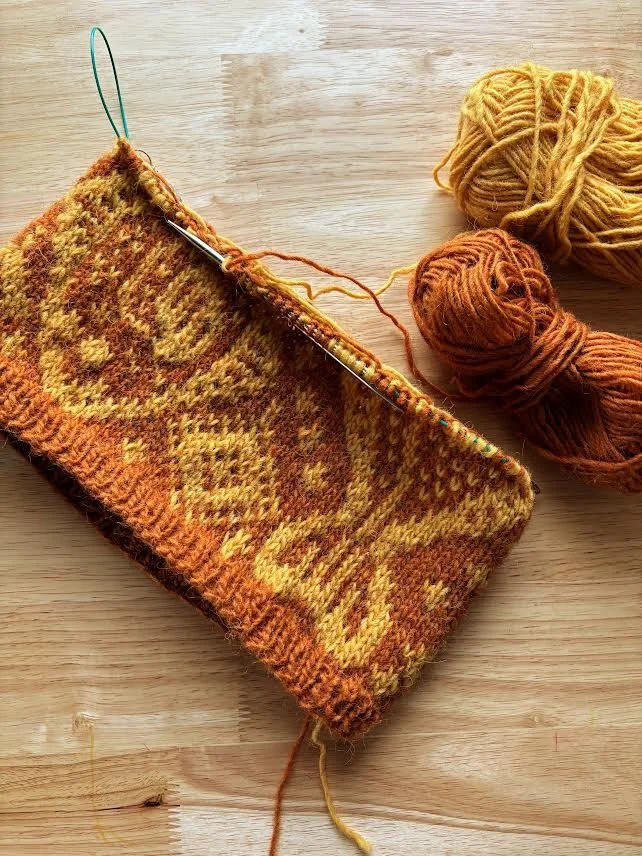
Current Project: Halibut Cowl